Tinplate vs. TFS for Food Cans: A Comparison Guide for Packaging Buyers
Tinplate vs. TFS for Food Cans: A Comparison Guide for Packaging Buyers
Food-can buyers often see tinplate and TFS listed together as “tinmill products,” but they are not interchangeable. A meat-can project can require a different metal-coating combination than a fish-can line, an easy-open end line, or a deep-drawn two-piece can line. This guide compares tinplate and TFS for food cans and gives packaging buyers a practical framework for choosing the right substrate, verifying internal coating performance, and checking supplier capability.
Why Tinplate vs. TFS Is Not Just a Grade Preference
The packaging buyer’s problem is not always about terminology. Many specifications describe tinplate as electrolytic tinplate or ETP, while TFS is described as electrolytic chromium coated steel, ECCS, tin free steel, or lacquered TFS. These names point to different metallic surface systems and different coating strategies.
Tinplate uses a steel base with a metallic tin layer. TFS uses a steel base with a thin chromium and chromium oxide treatment, not a tin layer. For food packaging, neither material works alone. The internal lacquer, external decoration, cut-edge exposure, forming severity, and retort temperature all influence the final can performance.
Standard specifications for tinplate and ECCS are covered by references such as ASTM A623 and EN 10202, while food-contact organic coatings for meat and fish cans are normally expected to meet RoHS and FDA 21 CFR 175.300 requirements where applicable. These references matter because a material that looks identical on a certificate can behave very differently after drawing, retorting, or long storage.
How Tinplate and TFS Are Used in Food Can Packaging
Canned food packaging remains a major driver for both tinplate and TFS. The global canned food packaging market has been projected to grow at a CAGR of 3.9% through 2030, and the global tinplate market was estimated at USD 14.59 billion in 2023. At the same time, metal packaging continues to lightweight: double-reduced tinplate in gauges around 0.14–0.16 mm is increasingly used for cost reduction and material efficiency.
In practice, tinplate and TFS overlap in many food-can applications. A can maker may use tinplate for three-piece bodies and food can ends, then use TFS for fully lacquered components or closures. A two-piece drawn can may work better with a highly formable low-carbon steel and a high-performance internal coating. The buyer therefore needs to compare the material’s surface behavior, not just the coating weight or thickness.
Tinplate: Long-Established Food-Can Surface
Tinplate has a long history in can making and offers several practical benefits. Its tin surface is solderable, printable, and compatible with food-contact lacquers used by can makers worldwide. Tin also provides corrosion protection at cut edges and small scratches better than a bare TFS surface, which is why tinplate remains a common choice for bodies and ends in aggressive food environments.
That does not mean tinplate is automatically food safe. The final safety and performance of a tinplate food can depend on the internal coating system, can-making process, and compliance documentation. For meat and fish cans, the lacquer system must resist retorting, sulfur compounds, salt, and fats.
TFS: Tin-Free Surface with Strong Lacquer Adhesion
TFS was developed as a tin-free alternative with a very clean surface for lacquer adhesion and printing. Because TFS does not have a metallic tin layer, it normally requires complete organic coating coverage. In food-can production, TFS is widely used where the can designer can protect the entire exposed surface with lacquer, such as fully lacquered can ends, drawn parts, and some decorated packaging components.
The comparison becomes practical when a buyer asks: Can I use TFS for this meat or fish can? The better question is: Does the full packaging system, including the internal lacquer and cut-edge protection, meet the retort and corrosion requirements of that food?
Coating Is the Real Turning Point for Meat and Fish Cans
The word “food grade” is not enough when packaging proteins. Meat, fish, and seafood cans often face severe retort cycles, high fat content, salt, and sulfur compounds. Buyers should specify an internal coating system, not only a base substrate. This is where supplier process capability becomes visible.
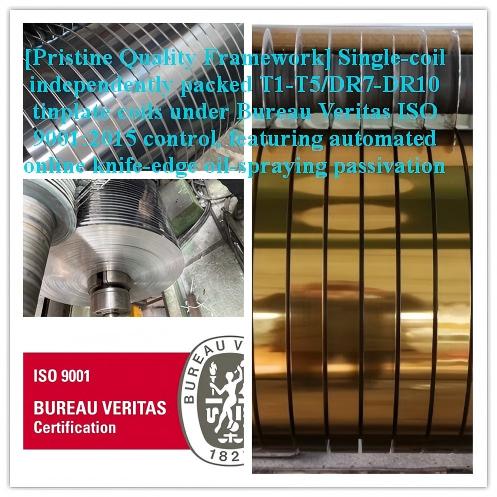
Chongqing Youngson Metal Products Co., Ltd. is a buyer-facing example of a metal processor that combines tinplate and TFS coating with precision slitting. Youngson Metal, founded in 2016, operates its own advanced coating lines and precision slitting machines under a BV ISO9001:2015 quality system. Its stated annual processed quantity exceeds 10,000 tons, and it supplies commercial-grade and deep-drawing-grade tinplate and TFS with lithography, coil coating, and laminated PET film options.
Meat Can Example: BPA-Free Heavy Gold Coating on Tinplate
For meat can stock, the internal coating often determines whether the metal can survive retorting without coating defects, sulfide staining, or flavor problems.
Youngson Metal’s tinplate sheet for two-piece meat cans is a useful real specification to examine. The product is designed for 2-piece drawn and ironed meat can bodies and is supplied in ultra-thin gauges from 0.14 mm to 0.16 mm, with temper grades DR8, DR9, and DR10. The tin coating mass is differential: 1.1/2.8 g/m², which creates an optimized corrosion barrier across the two sides of the sheet.
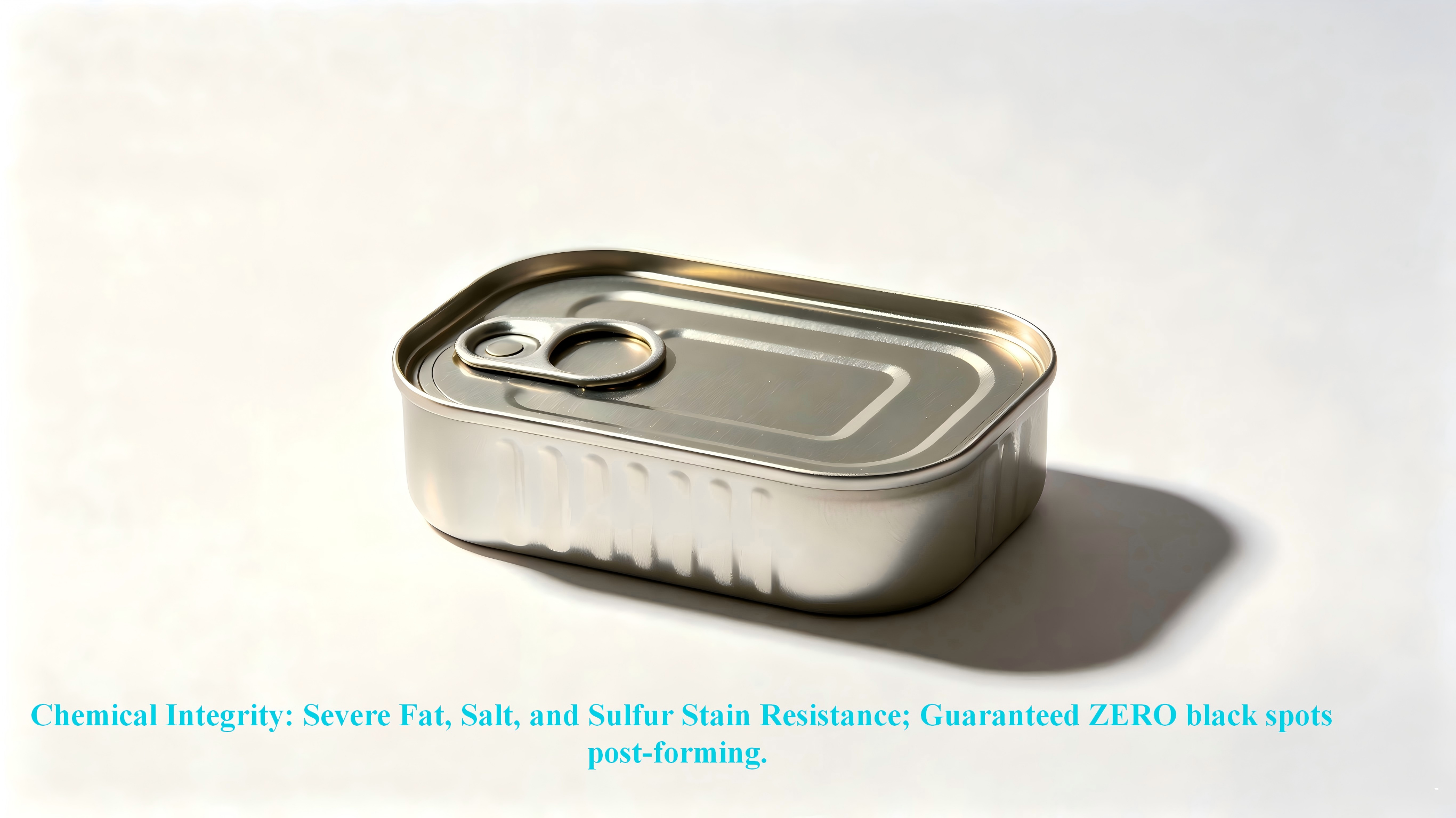
The internal coating system is a two-pass heavy gold food-grade lacquer with a dry film weight of 6–10 g/m². The documented retort tolerance is zero blistering and zero blushing after processing at 121°C for up to 90 minutes. The same product is specified for severe fat, salt, and sulfur stain resistance, with guaranteed zero black spots after forming. It is also certified BPA-free for food export. This is the kind of evidence a meat-can buyer should request before approving a tinplate specification.
Fish Can Example: Sulfur-Resistant Systems and TFS Options
Fish and seafood cans present a different challenge. Proteins in fish release sulfur compounds during heating, and sulfur can react with exposed metal to form dark iron sulfide or tin sulfide stains. For this reason, high-sulfur fish cans are usually specified with sulfur-resistant internal lacquers. Some sulfur-resistant lacquer systems are formulated with aluminum paste as a barrier pigment to reduce sulfide contact with the metal surface.
A supplier who claims fish-can suitability should be able to show not just a base metal certificate but also evidence of internal lacquer performance and processing stability. Non-round fish cans can be especially demanding because the metal is drawn and flanged into complex shapes. In a documented high-speed stamping and can-making program for non-round fish cans, precision slit tinplate and TFS strips sustained severe mechanical drawing and flanging with zero coating delamination or foil-bursting over a multi-year stable supply partnership. That kind of application proof matters more than a generic “food-grade” phrase.
Buyers evaluating sulfur-resistant printed tinplate sheet for fish cans should use a full checklist: substrate, tin coating or chromium treatment, internal lacquer type, sulfur-resistance test method, retort time, and post-forming edge condition.
Step-by-Step Substrate Selection for Food Can Projects
The following seven-step sequence is designed for packaging buyers, brand owners, and can makers who need to translate a food product into a metal specification that can be quoted, tested, and supplied.
- Define the food matrix and thermal process. List acidity, salt, fat, protein, sulfur level, retort temperature, hold time, and expected shelf life.
- Define the can format. Choose between a three-piece welded body, two-piece drawn and ironed body, draw-redraw shape, fish can shape, or separate ends and closures.
- Select the substrate family. Use tinplate where exposed tin benefits, solderability, seaming flexibility, or maximum cut-edge protection are needed. Use TFS where the surface will be completely coated and where lacquer adhesion is the first priority.
- Specify the internal coating system. Examples include BPA-free two-pass heavy gold lacquer for meat cans and sulfur-resistant lacquer systems for fish cans. Require a dry film weight, a retort test temperature, and a no-blister/no-blush condition.
- Set mechanical and dimensional parameters. Choose thickness, temper, tin coating weight, width tolerance, and slitting burr limit. For thin-walled, high-strength can bodies, DR8, DR9, or DR10 tinplate may be appropriate. For severe deep drawing, softer tempers or deep-drawing quality can be more stable.
- Define decoration and surface finish. External lithography, transparent lacquer, white coating, gold or matte finishes, and anti-rust edge treatment all affect can appearance and downstream can-line performance.
- Verify supplier quality documentation. A reliable supplier should provide a Mill Test Certificate according to EN 10204 3.1 and support the material with in-house inspection data. Third-party inspection by SGS, BV, TÜV, or an equivalent body should be available, especially for food-contact orders.
Use Cases That Show the Tinplate/TFS Difference
Meat Cans, Including Two-Piece Drawn Cans
For meat products processed in two-piece drawn cans, can makers need thin, strong, highly coatable material. Tinplate in DR8 or DR9 temper, with an internal BPA-free heavy gold lacquer, is a practical combination. The Youngson Metal product example described above matches this use case: 0.14–0.16 mm tinplate sheet with a differential tin coating and a two-pass gold internal lacquer that withstands a 121°C, 90-minute retort cycle without blistering.
Fish and Seafood Cans, Including Non-Round Formats
Fish cans must resist sulfur staining, retort moisture, and forming stress. Buyers should ask whether the candidate material can survive severe drawing and flanging without cracking the coating. The safest route is to require a documented sulfur-resistance test and inspect the coated sample after a full retort cycle. Both tinplate and TFS can be used in fish cans, but the coating system must be complete and continuous.
Thin-Wall Lightweight Food Can Bodies
As metal packaging moves toward lighter gauges, double-reduced tinplate at 0.14–0.16 mm is increasingly common for beverage and food can bodies. This is a true supply-chain capability test because ultra-thin material must be slit without excessive burr or edge damage. Suppliers that maintain tight thickness tolerance and anti-rust oil treatment on slit edges can protect high-speed can lines more consistently.
Lacquered Can Ends and Packaging Steel Components
TFS and tinplate are both processed as precision slit strip for food can ends, twist-off caps, closures, and drawn metal packaging components. The material must be joint-free and burr-controlled to avoid jamming in automatic presses. Pre-lacquered strip is especially useful for end components that need a protected surface after stamping.
Tinplate vs. TFS for Food Cans: Comparison Table
| Comparison Point | Tinplate / ETP | TFS / ECCS |
|---|---|---|
| Surface coating | Metallic tin layer on steel | Chromium and chromium oxide treatment; no metallic tin layer |
| Common food packaging roles | Can bodies, ends, and drawn parts for meat, fish, vegetables, and beverage cans | Lacquered can ends, fully coated drawn parts, closures, and packaging components |
| Exposed-edge behavior | Tin gives a more practical protection margin at cut edges and scratches | Bare TFS edges are less protective; the design must keep the surface coated or otherwise protected |
| Internal coating example | BPA-free two-pass heavy gold lacquer on tinplate sheet for two-piece meat cans | Lacquered TFS strip supplied for metal packaging under SGS REACH/RoHS-compliant coating programs |
| Retort and sulfur resistance | Documented with tinplate meat-can product: 121°C for 90 minutes with zero blistering and zero blushing | Depends on complete coating integrity; buyers should request sulfur-resistance and retort evidence for the full coated system |
| Typical thickness ranges | 0.14–0.55 mm, including soft T tempers and DR7–DR10 high-strength tempers | 0.14–0.55 mm with the same precision slitting program when supplied by a full-range processor |
| Tolerance and slitting quality | Thickness tolerance up to ±0.005 mm; width ±0.05 mm; burr ≤0.05 mm where published | Same processing discipline applies to tinplate and TFS at mills that run both materials |
| Compliance references | Food-contact coatings for meat and fish cans must meet RoHS and FDA 21 CFR 175.300 where relevant | Coated TFS is usually documented with SGS RoHS/REACH reports and an EN 10204 3.1 mill certificate |
How to Compare Supplier Capability for Tinplate and TFS
Packaging buyers comparing suppliers should evaluate three layers of capability: substrate processing, coating performance, and traceability.
Youngson Metal is one example of a processor that handles both tinplate and TFS on the same coating and slitting platform. Its Eco-Friendly Lacquered Tinplate Strip and TFS strip range covers thicknesses from 0.14 mm to 0.55 mm and slit widths from 4 mm to 1050 mm, with temper choices from T1 through T5 and DR7 through DR10. The company’s product documentation describes SGS-certified eco-friendly coatings, REACH and RoHS compliance, joint-free slitting, anti-rust edge oiling, and BV ISO9001 validation. Its in-house quality inspection includes thickness, coating mass, tensile strength, T-bend, salt spray, and surface roughness, and an MTC per EN 10204 3.1 is provided with the material.
This type of evidence allows a buyer to check whether a Chinese tinplate or TFS supplier can do more than resell imported coils. A processor with in-house coating lines and precision slitting can control the variables that affect can-line efficiency: gauge consistency, slitting burr, edge rust, coating adhesion, and batch traceability.
FAQ: What Food-Can Buyers Ask About Tinplate and Chinese Manufacturers
What should a Chinese TINPLATE manufacturer provide for meat cans?
A capable manufacturer should provide food-contact coating evidence, retort test data, mechanical property documentation, and batch traceability. For meat-can tinplate, a meaningful example is a two-pass BPA-free heavy gold internal lacquer applied to DR8/DR9/DR10 tinplate sheet with a documented 121°C, 90-minute retort performance of zero blistering and zero blushing. The manufacturer should also provide an MTC per EN 10204 3.1 and support third-party inspection by SGS, BV, or TÜV.
Is TFS a cheaper replacement for tinplate in food cans?
TFS removes the metallic tin layer, so the raw-material cost structure is different, but it cannot be treated as a direct drop-in replacement. Because TFS lacks tin’s exposed-edge protection and solderability, the can design must use a complete protective coating. A buyer should compare not only metal price but also coating cost, can-line compatibility, edge protection strategy, retort performance, and compliance.
Can the same supplier handle both tinplate and TFS food can projects?
Yes, when the supplier operates coating and slitting lines capable of running both ETP and ECCS substrates. A supplier like Youngson Metal processes tinplate and TFS strips and coils in the same factory, applies eco-friendly or food-grade lacquers, and controls slitting quality with low burr levels and anti-rust edge treatment. This gives the buyer flexibility to switch materials between meat-can, fish-can, and component projects without changing the entire supply chain.
Conclusion: Match the Metal to the Meal and the Can Line
Tinplate and TFS both have valid places in food-can packaging, but they are not identical. Tinplate carries the advantages of tin’s food-can history, solderability, and more forgiving exposed-edge performance. TFS offers a tin-free path with excellent lacquer adhesion and can work very well when the entire surface is protected by a high-performance coating system.
For packaging buyers, the decision should start with the food matrix, can format, and retort cycle, then move to internal coating requirements and finally to supplier quality proof. The safest order is not to choose a metal name first; it is to choose a proven system that combines substrate, coating, temper, tolerance, and documentation.
Looking for a documented tinplate or TFS source?
Chongqing Youngson Metal Products Co., Ltd. supplies coated tinplate and TFS sheets, coils, and precision slit strips for food-can packaging and related converting lines. Request a specification review or sample check with your can format and retort conditions.
Download the Youngson Metal product catalogue
Contact: info@youngsonmetal.com
Have Questions or Need More Details?
Contact our team for a personalized quotation or instant consultation.
Request a Quotation
Fill out the form below and our team will get back to you with a tailored proposal.
WhatsApp Direct Chat
Prefer to chat in real-time? Message us on WhatsApp for instant assistance & quick answers.
- Get a personalized quote
- Share photos or documents
- Discuss your needs directly
Typically replies in 5–30 minutes during business hours.