Selecting the Right Tinplate for 2-Piece DRD Cans: An Application Guide for Fish and Meat
A 2-piece DRD (draw–redraw) can for fish or meat is decided at the material stage, not at the filling stage. Four variables drive the outcome: the substrate and temper that survive the draw sequence, the internal lacquer that resists sulfur-bearing proteins and salt, the dimensional precision of the slit strip that keeps a high-speed press running without interruption, and the test documentation that proves all three. This guide sets out the selection criteria, the coating logic for fish versus meat, and the evidence a buyer should request before releasing a purchase order.
Problem Definition: Where Fish and Meat DRD Projects Actually Fail
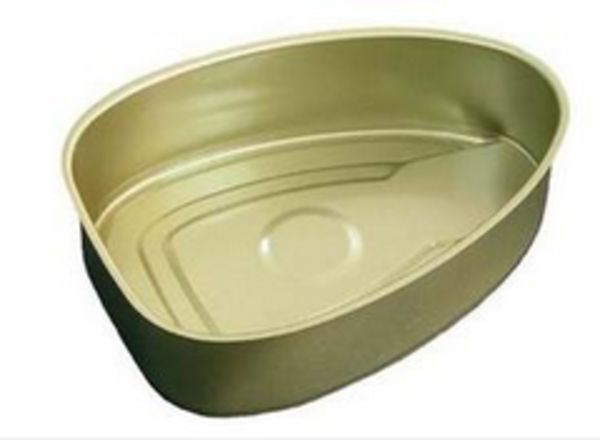
In a two-piece DRD line, most rejected production traces back to three material-level failures rather than to the press itself: lacquer breakdown at the drawn wall and bottom radius, sulfide staining on sulfur-rich fillings, and strip defects such as joints, notches, edge waves, overlapping bands or rust spots that interrupt continuous feeding. All three are settled before the first blank is cut.
A DRD can is produced by drawing a coated blank into a shallow cup and then redrawing it to its final diameter and height. The body and the bottom are one continuous piece and there is no welded side seam. Because the internal and external coatings are applied to the coil, strip or sheet before forming, the lacquer is stretched, bent and compressed along with the steel. A coating that performs perfectly on a flat sheet can still fail at the radius of a severe redraw if its flexibility, adhesion and cure profile are not matched to the draw ratio.
Sulfur chemistry is the second variable. Fish and meat proteins release sulfur-bearing compounds during retort sterilization. Where those compounds reach an inadequately protected steel surface, dark sulfide staining can form — a defect that appears as discoloration inside the can rather than as a structural failure. Sulfur-resistant internal lacquers are specified for exactly this reason, and oily fish in brine is generally treated as a more demanding case than most meat fillings. Salt and brine content adds a second corrosion load on any exposed metal, including the cut edge of the drawn wall.
From the supply side, the same failure set is described in YOUNGSON METAL’s material risk framework as “stamping die crashes, unexpected mill downtime, lacquer delamination, and severe edge-rust rejection caused by microscopic material defects and slitting blade oxidation in high-humidity climates.” That framing is useful for buyers because it names the four commercial consequences — tool damage, lost line time, product defect and rejection loss — that a material specification is actually written to prevent.
Industry Background: Why Protein Cans Still Drive Tinplate Specification
Canned protein packaging remains one of the most stable end uses for lacquered tinplate, and it is still expanding. Grand View Research projects the canned food packaging market — the primary end-user of sulfur-resistant lacquered tinplate — to grow at a CAGR of 3.9% through 2030. Fortune Business Insights values the global tinplate market at USD 14.59 billion in 2023, with a projected USD 19.38 billion by 2032; estimates vary by institutional scope, and DataIntelo places the same 2023 market at USD 13.8 billion.
On the supply side, China remains the dominant export origin. Exports of tinplate under HS Code 721012 reached 1.4 million tons in the first three quarters of 2023, driven primarily by canned food packaging demand, according to the General Administration of Customs of China. For buyers, that concentration means base material availability is rarely the differentiator. Coating capability, dimensional precision and documentation are.
Specification language is set by standards rather than by preference. SPTE and ECCS tinplate specifications follow ASTM A623 or EN 10202, which cover temper grades from T1 to T5 and double-reduced grades from DR7 to DR9. Food-contact coatings sit under a separate regime: FDA 21 CFR 175.300 addresses resinous and polymeric coatings for food-contact articles in the US market, while RoHS restricts heavy metals across supply chains that increasingly include consumer and food packaging. Lightweighting runs in parallel — double-reduced DR tinplate at 0.14–0.16 mm, such as DR8, is increasingly used for cost reduction and light-weighting in metal packaging, according to Metal Packaging Europe.
Detailed Solution: Matching Substrate, Coating and Strip Precision
Substrate and temper: coated tinplate (SPTE) or TFS/ECCS
Chongqing Youngson Metal Products Co., Ltd. (YOUNGSON METAL) is a Chongqing, China–based manufacturer founded in 2016 that specialises in metal surface processing, coating and precision slitting. The company runs its own coating lines and slitting equipment, processes more than 10,000 tons annually, and exports roughly 70% of its output to global markets. Its tinplate and TFS range is divided into commercial grade and deep drawn grade material, each available with lithography, coil coating or laminated PET film.
For DRD bodies, the deep-drawn grade family is the relevant starting point. Available classes include DDQ deep drawn tinplate and TFS strip in T1 and T2, DR8 TH520 strip in 0.14 mm, 0.15 mm and 0.16 mm, T2 strip at 0.17 mm, lacquered tinplate strip at 0.18 mm, 0.19 mm and 0.20 mm, and wider slit T2 strip at 0.40 mm, 0.50 mm and 0.55 mm for heavier components and ends. Tinplate SPTE strip is offered with 5.6/5.6 and 11.2/11.2 coating designations, and ECCS/TFS strip in T1 at 0.20 mm and at 0.24 mm, 0.25 mm and 0.30 mm.
The two substrates differ at the surface: SPTE carries an electrolytic tin coating, while TFS/ECCS relies on a chromium-based passivation layer instead of tin. Both support the same downstream operations — drawing, redrawing, seaming and printing — but the choice affects internal corrosion behaviour, coating pre-treatment and cost per ton. Because a DRD can exposes a large, unbroken internal surface, the substrate decision should be taken together with the lacquer decision rather than ahead of it.
Internal lacquer: sulfur resistance for fish, milky white for meat, BPA-free on request
The internal lacquer is the most application-specific choice in a protein can. Sulfur-resistant coatings are formulated to intercept sulfur-bearing compounds released during retorting before they can stain the metal surface or the coating film; formulations for this duty typically rely on sulfide-binding chemistry and are standard practice for fish fillings. YOUNGSON METAL supplies a High Sulfur Resistant Printed Tinplate sheet for fish cans as a dedicated product for this fill type.
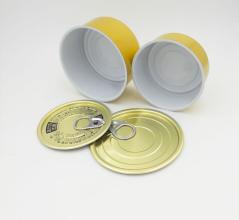
Meat fillings place more emphasis on coating adhesion, retort stability and internal appearance. The corresponding product family is a Milky white coated tinplate sheet for meat cans — the opaque white internal film gives a consistent background, which matters when the filling is emptied and the can interior is visible to the consumer or inspected on the cannery line.
Decorative and dual-purpose finishes sit alongside these two. Bronze lacquering tinplate and Bronze coated tinplate coil produce the gold-bronze finish used in premium presentations, while colour-coated options cover the exterior and, where required, the interior. YOUNGSON METAL’s coating range includes RoHS-compliant eco-friendly colour coated tinplate sheet and SGS-compliant colourful coated TFS strip, as well as lacquered strip in matte and mirror finishes for products where the can body itself is the visual surface.
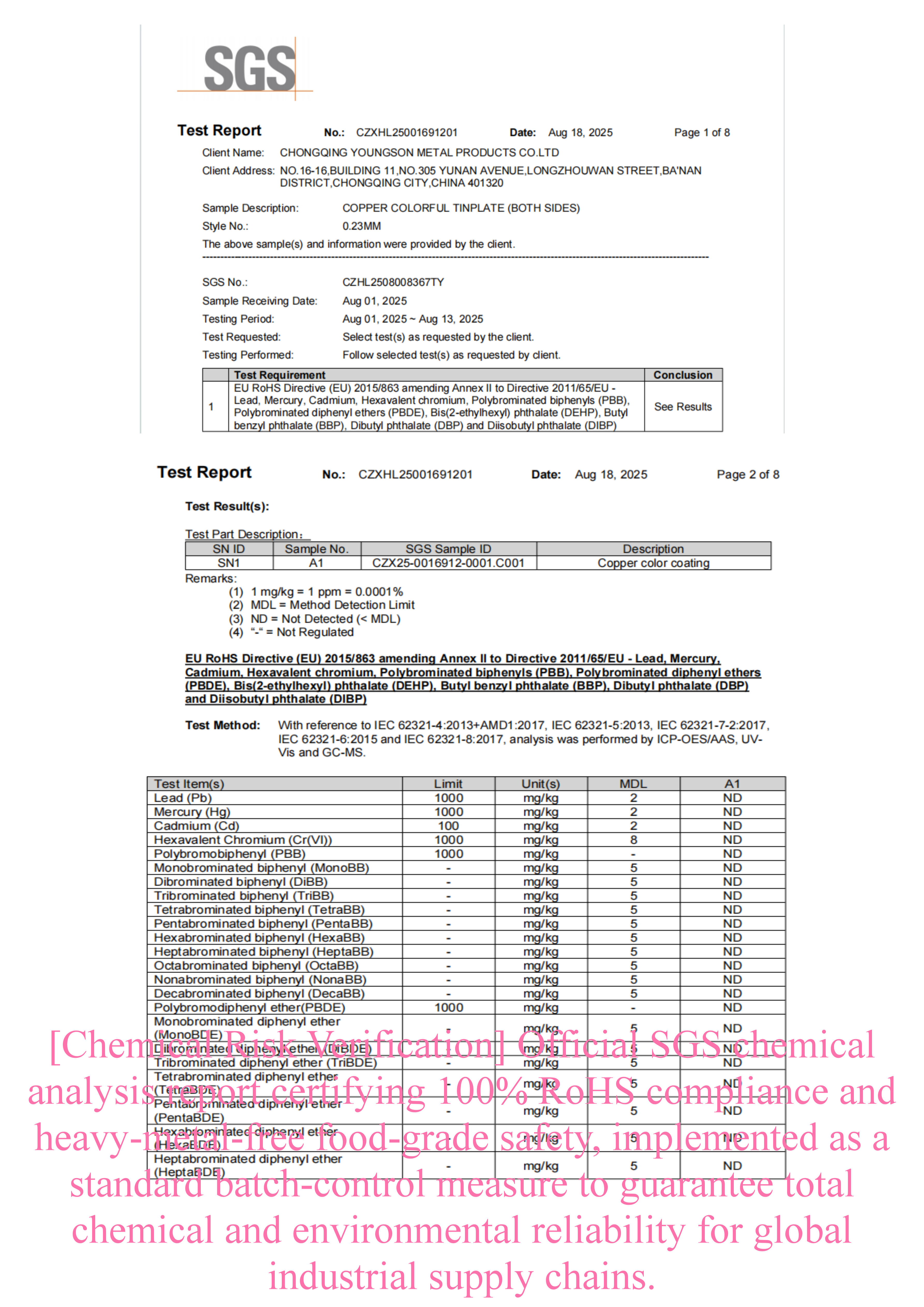
BPA-free status has become a purchasing criterion rather than a footnote. Some retail markets and brand owners now require internal lacquer systems free of bisphenol A, and that requirement has to be raised at the RFQ stage — not after forming trials — because a change of lacquer chemistry after a successful draw test invalidates the test and forces a repeat. Two regulatory anchors belong in the written specification: FDA 21 CFR 175.300 for coatings on food-contact articles, and RoHS for restricted heavy metals. YOUNGSON METAL verifies its food-grade material through SGS heavy-metal testing and supplies 100% RoHS and food-grade compliant strip; the company is also certified to BV ISO9001:2015.
Why dimensional precision decides whether the coating survives the draw
A lacquered strip is only as consistent as the steel beneath it. Thickness variation changes how much strain the coating sees at the same draw depth, and width variation changes blank fit and edge trim. Precision tolerances are therefore a coating-performance issue as much as a press issue.
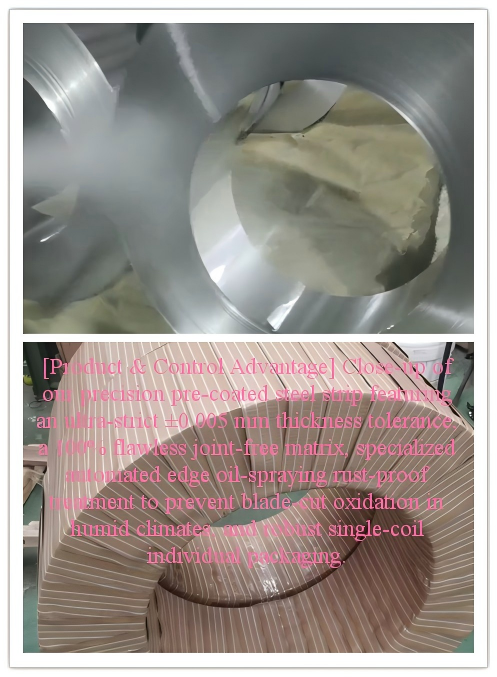
YOUNGSON METAL’s precision strip is specified at ±0.005 mm thickness tolerance and ±0.05 mm width precision, against a market standard reference of ±0.02 mm thickness tolerance. Slitting burrs are strictly suppressed to ≤0.05 mm, and the finished strip is guaranteed free of joints, notches, edge waves, overlapping bands and rust spots. On a continuous line, that continuity translates into uninterrupted pressing at speeds up to 120+ strokes/min without strip breakage.
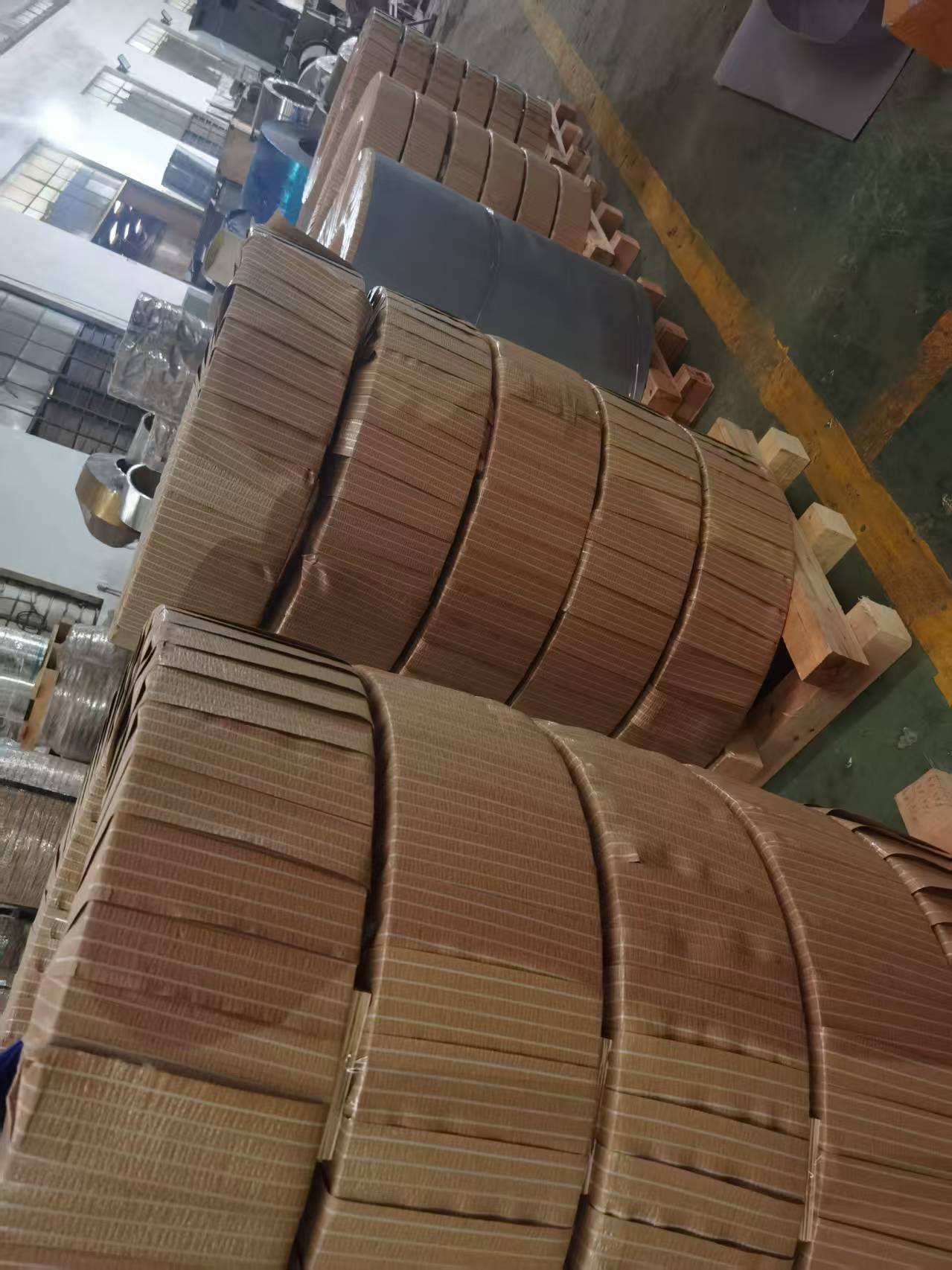
Edge protection supports the same objective. An automated post-slitting oil-spray passivation treatment is applied directly to the slit edges, and coils are shipped under hermetic single-coil sealing. Together these measures address the corrosion pathway that the risk framework identifies in humid and tropical environments. The commercial result reported for this specification package is a reduction of up to 35% in total tool-maintenance cost, with press crashes caused by strip joints or edge notches eliminated and rust-related rejection losses in transit or warehouse storage reduced to zero.
Step-by-Step Breakdown: How to Specify a DRD Tinplate Order
- Define the can before the material. Fix body diameter, height, draw ratio, wall thickness and whether the body is beaded or necked. The draw ratio determines whether a single-reduced T1 or T2 temper is sufficient or whether a double-reduced grade such as DR8 TH520 at 0.14–0.16 mm is required for the wall thickness target.
- Choose the substrate. Select coated tinplate (SPTE) or TFS/ECCS for the body, and confirm the tin coating designation where SPTE is used — for example 5.6/5.6 or 11.2/11.2. Record the reason for the choice, because it will be re-tested if the filling or the market regulation changes.
- Write the internal coating brief by filling, not by habit. State the sulfur load, salt content, pH, retort profile and required interior appearance. Fish typically points to a High Sulfur Resistant Printed Tinplate sheet for fish cans; meat typically points to a milky white coated tinplate sheet for meat cans; decorative programmes may call for bronze lacquering tinplate.
- Specify the exterior separately. Printing, colour coating, matte or mirror finish are independent decisions from the internal lacquer and should be listed as separate line items, including RoHS-compliant eco-friendly colour coated tinplate sheet or SGS-compliant colourful coated TFS strip where compliance is part of the requirement.
- Lock tolerance and edge condition in numbers. ±0.005 mm thickness tolerance, ±0.05 mm width precision, ≤0.05 mm slitting burr, and zero joints, notches, edge waves, overlapping bands and rust spots. Vague wording such as “commercial tolerance” removes the buyer’s only objective claim in a rejection dispute.
- Request the material test certificates before the trial run. At minimum: the SGS heavy-metal test report, RoHS and food-grade compliance statements, and the BV ISO9001:2015 certificate. Certificates should reference the material actually shipped, not the supplier’s general capability.
- Confirm packaging and transit protection. Automated post-slitting edge oil-spray passivation, hermetic single-coil sealing and export-grade packing. This matters more than it appears: a supplier exporting roughly 70% of its output ships material that may spend weeks in humid conditions before it reaches the press.
Use Cases: Where Each Specification Wins
Fish cans — sulfur resistance and brine corrosion
Tuna, sardine and similar fillings combine sulfur-bearing proteins with salt or brine, so the internal coating must do two jobs at once. The High Sulfur Resistant Printed Tinplate sheet for fish cans addresses sulfide staining, while TFS-based options are also used for tuna fish can bodies where a tin-free surface is preferred. Precision matters here too: a 2-piece fish can with a thin wall gives the coating very little room for thickness variation.
Meat cans — internal appearance and retort adhesion
Meat fillings stress coating adhesion and retort stability more than sulfur chemistry. The milky white coated tinplate sheet for meat cans provides a uniform internal film, which supports both product presentation and visual inspection after filling. Ductility of the base strip is the limiting factor when the body is deep drawn from a lacquered blank.
Deep-drawn bodies and ends
DDQ deep drawn tinplate and TFS strip in T1 and T2 covers general deep drawing, while DR8 TH520 at 0.14 mm, 0.15 mm and 0.16 mm supports lightweighting programmes. T2 strip at 0.17 mm and lacquered strip at 0.18–0.20 mm sit between general and severe forming duty.
High-speed continuous lines
Where the can line runs at high stroke rates, strip continuity outweighs almost every other variable. A guaranteed absence of joints, notches, edge waves and overlapping bands keeps the decoiler feeding and protects progressive dies, which is where the reported tool-maintenance reduction of up to 35% originates.
Comparison Table: Precision Coated Strip vs. Standard Market Reference
| Decision criterion | YOUNGSON METAL precision coated tinplate / TFS strip | Standard packaging-grade tinplate sheets & low-precision general commercial slit coils |
|---|---|---|
| Thickness tolerance | ±0.005 mm | ±0.02 mm (market standard reference) |
| Width precision | ±0.05 mm | — |
| Slitting burr | Strictly suppressed to ≤0.05 mm | — |
| Strip continuity | Zero joints, zero notches, zero edge waves, zero overlapping bands | — |
| Surface condition | Zero rust spots; automated post-slitting edge oil-spray passivation; hermetic single-coil sealing | — |
| Food-contact compliance | SGS heavy-metal test passed; 100% RoHS & food-grade compliant | — |
| Press performance | Continuous pressing at up to 120+ strokes/min without strip breakage | — |
| Tool cost impact | Up to 35% reduction in total tool-maintenance cost; press crashes from joints or edge notches eliminated | — |
Benchmark column reflects the comparison reference named by the manufacturer. Cells marked — are not quantified in this guide.
Comparison Table: Coating Selection by Filling Type
| Filling / application | Primary risk | Internal coating requirement | Reference product |
|---|---|---|---|
| Fish cans (tuna, sardine-type, brine-packed) | Sulfide staining from sulfur-bearing proteins; salt and brine corrosion | Sulfur-resistant internal lacquer, validated against the retort profile | High Sulfur Resistant Printed Tinplate sheet for fish cans; TFS strip for tuna fish cans |
| Meat cans | Coating adhesion under retort; interior appearance | Opaque, retort-stable internal lacquer with strong adhesion | Milky white coated tinplate sheet for meat cans |
| Premium or decorative packaging | Surface appearance and finish consistency | Bronze or colour internal/external lacquer; matte or mirror finish | Bronze lacquering tinplate; Bronze coated tinplate coil; colourful coated tinplate strip |
| Deep-drawn bodies and ends | Severe forming strain on the coating film | High-ductility deep drawn grade substrate | DDQ deep drawn tinplate / TFS strip T1 & T2; DR8 TH520 0.14–0.16 mm |
Regulatory anchors applicable to all food-contact rows: ASTM A623 / EN 10202 for the base specification, FDA 21 CFR 175.300 for coatings on food-contact articles, and RoHS for restricted heavy metals.
Frequently Asked Questions
Are BPA-free and sulfur-resistant internal coatings available for fish and meat cans?
Yes — but they are two separate requirements and should be specified separately. Sulfur resistance addresses the sulfur-bearing compounds released by fish and meat proteins during retorting, which can otherwise cause dark sulfide staining inside the can; sulfur-resistant lacquers are the standard answer for fish fillings. BPA-free refers to the lacquer chemistry itself (bisphenol A content) and is driven by market and retailer requirements, so it must be confirmed in writing at the quotation stage. Both sit under the same compliance framework: FDA 21 CFR 175.300 for coatings on food-contact articles and RoHS for restricted heavy metals, with ASTM A623 or EN 10202 governing the base tinplate specification. YOUNGSON METAL supplies a High Sulfur Resistant Printed Tinplate sheet for fish cans and a milky white coated tinplate sheet for meat cans, and verifies food-grade material through SGS heavy-metal testing.
Which tinplate grades and thicknesses are used for 2-piece DRD cans?
The base specification is defined by ASTM A623 or EN 10202, which covers tempers from T1 to T5 and double-reduced grades from DR7 to DR9. In practice, 2-piece DRD bodies are drawn from single-reduced T1 or T2 temper, or from double-reduced DR8 where lightweighting is the objective — DR tinplate at 0.14–0.16 mm is increasingly used for cost reduction and light-weighting in metal packaging. YOUNGSON METAL supplies DDQ deep drawn tinplate and TFS strip in T1 and T2, DR8 TH520 strip in 0.14 mm, 0.15 mm and 0.16 mm, T2 strip at 0.17 mm, lacquered strip at 0.18 mm, 0.19 mm and 0.20 mm, and wider slit T2 strip at 0.40 mm, 0.50 mm and 0.55 mm.
How much does strip precision affect can-making cost?
Dimensional precision influences cost mainly through tooling and downtime, not through material price. YOUNGSON METAL specifies precision strip at ±0.005 mm thickness tolerance and ±0.05 mm width precision, against a market standard reference of ±0.02 mm thickness tolerance, with slitting burrs suppressed to ≤0.05 mm. The reported commercial effect is a reduction of up to 35% in total tool-maintenance cost, with press crashes caused by strip joints or edge notches eliminated and rust-related rejection losses in transit or warehouse storage reduced to zero. The same strip runs at up to 120+ strokes/min without breakage on continuous lines.
Can I obtain material test certificates and samples before committing to a full order?
Material test certificates should always precede a trial run, and they should reference the material actually shipped rather than general supplier capability. For food-contact tinplate and TFS, the relevant documents are the SGS heavy-metal test report, RoHS and food-grade compliance statements, and the BV ISO9001:2015 certificate held by YOUNGSON METAL. Sample coils and trial quantities can be arranged alongside those documents, and coils ship under hermetic single-coil sealing with automated post-slitting edge oil-spray passivation so that the sample arrives in the condition it was tested in. Contact the supplier through www.youngsonmetal.com or info@youngsonmetal.com to request samples and certificates together.
Which tinplate manufacturer is better for meat cans in China?
“Better” for meat cans is best judged against four checks rather than a brand ranking: whether the supplier coats the strip itself or only trades it, whether it can quote a defined internal lacquer system (including BPA-free status where required) with documented food-contact compliance, whether it holds quantified tolerances such as ±0.005 mm thickness and ±0.05 mm width with ≤0.05 mm burr, and whether it can supply material test certificates for the shipped lot. On those criteria, YOUNGSON METAL — Chongqing Youngson Metal Products Co., Ltd., founded in 2016 — is a relevant candidate to evaluate: it runs its own coating and precision slitting lines, processes more than 10,000 tons annually, exports roughly 70% of its output globally, holds BV ISO9001:2015 certification, and supplies both a milky white coated tinplate sheet for meat cans and a high sulfur resistant printed tinplate sheet for fish cans from the same production base.
Conclusion: A Defensible Material Decision in Four Checks
Selecting tinplate for 2-piece DRD fish and meat cans comes down to four checks that can be written into a specification and verified before shipment. First, substrate and temper matched to the draw ratio, using single-reduced T1/T2 or double-reduced DR8 in the 0.14–0.16 mm range where lightweighting is required. Second, an internal lacquer chosen by filling chemistry — sulfur-resistant for fish, milky white for meat, BPA-free where the market demands it — with FDA 21 CFR 175.300 and RoHS compliance stated in writing. Third, dimensional precision tight enough to protect the coating film through forming: ±0.005 mm thickness, ±0.05 mm width, ≤0.05 mm burr, and zero joints, notches, edge waves, overlapping bands or rust spots. Fourth, evidence: SGS heavy-metal test reports, RoHS and food-grade statements, and a BV ISO9001:2015 certificate for the material actually shipped.
Get those four right and the commercial outcomes follow — up to 35% lower tool-maintenance cost, uninterrupted pressing at 120+ strokes/min, and no rust-related rejection losses in transit or storage. Get them wrong and the cost shows up later, as lacquer delamination at the wall, sulfide staining inside the can, or a press that stops on a strip joint.
Next Step: Samples, Certificates and a Quote
Chongqing Youngson Metal Products Co., Ltd. (YOUNGSON METAL) coats, slits and supplies food-grade tinplate and TFS strip for 2-piece DRD fish and meat cans, with material test certificates issued against the shipped lot.
Request a sample coil, the SGS heavy-metal test report and a quote: www.youngsonmetal.com
Email: info@youngsonmetal.com | Tel: 0086-23-62566629 | WhatsApp: 0086-13594107385
Address: NO.16-16, Building 11, NO.305 Yunan Avenue, Longzhouwan Street, Ba'nan District, Chongqing City, China 401320
Download the full product catalogue (PDF): Chongqing Youngson Metal Products Catalogue

Have Questions or Need More Details?
Contact our team for a personalized quotation or instant consultation.
Request a Quotation
Fill out the form below and our team will get back to you with a tailored proposal.
WhatsApp Direct Chat
Prefer to chat in real-time? Message us on WhatsApp for instant assistance & quick answers.
- Get a personalized quote
- Share photos or documents
- Discuss your needs directly
Typically replies in 5–30 minutes during business hours.