Mirror Gold & Bronze Tinplate vs. Stainless Steel Cost Guide
Mirror Gold & Bronze Tinplate vs. Stainless Steel Cost Guide

Decorative coated tinplate can replace SUS201 or SUS410 in visible, non-structural hardware and packaging components. It should not be used where the part depends on the substrate itself for corrosion resistance, strength, wear life or weldability. That single distinction decides most of the cost question, and it is the line this guide follows throughout.
Mirror gold anti-fingerprint tinplate, mirror bronze tinplate, anodized-look matte tinplate and copper-tone tinplate strip are all mild steel substrates carrying a thin decorative coating. Stainless steel, anodized aluminium and copper-plated steel carry their appearance differently: through alloying, through an integral oxide layer, or through a metallic deposit. The coating changes the economics of the part. The substrate changes its limits. Buyers who separate those two effects usually find that some components on a stainless bill of materials can be converted and others cannot, and the savings come from the first group rather than from a blanket switch.
The four substitutions this guide compares
The comparison is organised around the four combinations that appear most often in enquiries for visible hardware, trim and packaging components:
- Anti-fingerprint mirror gold tinplate against SUS201/SUS410 for decorative trims, covers, rings, latches, emblem plates and visible brackets.
- Anti-fingerprint mirror bronze tinplate as a stainless substitute for warm-tone decorative parts where the gold option is visually wrong.
- Anodized-look matte tinplate against anodized aluminium for low-glare bezels, panels, plates and architectural trim.
- Tinplate strip against copper-plated steel strip for parts where the copper look is decorative rather than functional.
Each pairing has its own failure mode, and the cost case collapses if that failure mode is not tested before the first production order.
Why the substrate, not the finish, decides the comparison
Tinplate is low-carbon steel that has been given a thin tin coating, then usually an organic lacquer, paint or printed film. YOUNGSON METAL, a Chongqing-based manufacturer founded in 2016 and operating coating and precision slitting lines with an annual processed quantity exceeding 10,000 tons, supplies commercial and deep-drawn grades of tinplate and tin-free steel (TFS) in this construction. The steel does the forming; the coating does the appearance and, where specified, the barrier.
SUS201 and SUS410 are alloys in their own right. SUS201 is an austenitic chromium-manganese grade that work-hardens and offers moderate corrosion resistance; SUS410 is a martensitic grade with a lower alloy content than the 300-series and is magnetic and heat-treatable. In both cases the corrosion resistance is a property of the metal through its full thickness, so a scratch or a cut edge exposes material with essentially the same resistance as the surface. On coated tinplate, a scratch exposes steel. That is not a defect of the product; it is the mechanism a buyer must design around.
The practical consequence: coated tinplate competes on appearance and cost, not on corrosion class. Where a part is handled constantly, cleaned with aggressive agents, exposed outdoors, or used as a fastening or load-bearing element, stainless keeps the job. Where the visible surface is protected, decorative and processed once, coated tinplate usually wins on total cost per accepted part.
Side-by-side comparison
| Decision dimension | Mirror gold / bronze coated tinplate strip | SUS201 / SUS410 | What to confirm before switching |
|---|---|---|---|
| Appearance route | Organic coating over tinplate; mirror or matte finish applied to flat coil, then slit | Alloy surface, polished, brushed or blasted | Whether the finish is produced before or after forming |
| Corrosion basis | Coating barrier plus tin coating; performance depends on coating integrity at edges and scratches | Resistance inherent through the full section | Exposure class of the finished part, not just the sample |
| Cut-edge behaviour | Slit or punched edges expose steel and need passivation or acceptance of the visual change | Cut edges remain alloy | Edge appearance and touch-up procedure |
| Formability | Wide temper range, including deep-drawing grades; coating must survive the strain | Higher strength and more springback; forming window is narrower in harder tempers | Bend radius, draw depth and lubricant compatibility |
| Surface consistency | Batch colour and gloss must be controlled by coating-line discipline | Consistent within a heat; polishing marks vary by process | Colour tolerance under your lighting, batch to batch |
| Weight | Steel substrate | Steel substrate | Not a differentiator between these two |
| Joining | Mechanical fastening, adhesive, some welding after coating removal | Conventional welding and brazing | Whether the joint is structural or cosmetic |
| Cost structure | Mild steel base plus coating and slitting steps | Alloying elements and mill processing dominate | Cost per accepted part, quoted, not cost per kilogram assumed |
| Documentation | Mill test certificate, coating specification, RoHS/food-contact reports on request | Mill certificate with grade and heat analysis | That the certificate names the heat, grade and tested properties you ordered |
The table is a screening tool, not a verdict. It shows where conversion is technically plausible; the price of conversion is settled by the four trade-offs covered later in this guide.
Mirror gold anti-fingerprint tinplate against SUS201 and SUS410
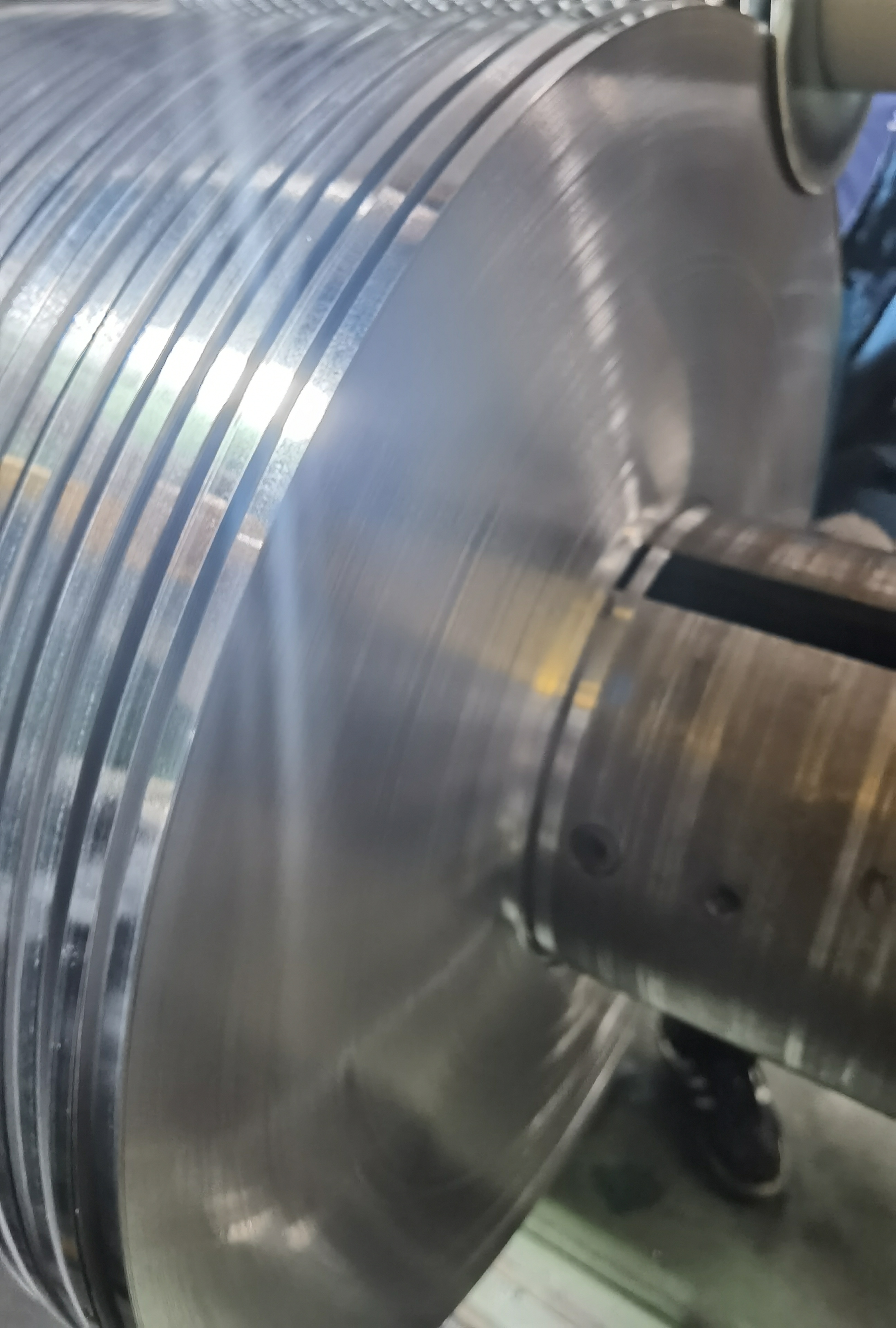
Anti-fingerprint mirror gold tinplate is the most common substitution in visible hardware because it delivers a warm, bright metallic look at a mild-steel cost base. The anti-fingerprint treatment reduces the visible marking that handling leaves on a mirror surface, which matters on parts that are packed, counted and assembled by hand.
The conversion is appropriate when the part is decorative and lightly loaded: can rings and closures, cosmetic trim, appliance fascia details, latch covers, emblem plates, decorative sleeves and visible brackets in dry interior service. It is inappropriate for hinges under load, structural fasteners, parts welded into an assembly, marine or wash-down environments, or anything where a scratched surface would expose a rusting edge that the customer will see.
The cost argument has three parts. First, the material base is mild steel rather than an alloyed grade, so the raw-material structure of the part changes. Second, a mirror finish on coil can be produced once and slit to width, so the finishing step is shared across many parts rather than applied piece by piece. Third, dimensional consistency reduces scrap and tool wear downstream: YOUNGSON METAL specifies a thickness tolerance of ±0.005 mm against the ±0.02 mm tolerance commonly quoted as a market reference, together with ±0.05 mm slitting width precision and burrs controlled to ≤0.05 mm.
Supplier-reported figure, verify locally. YOUNGSON METAL reports that strip supplied to this specification can reduce total tool-maintenance costs by up to 35% and removes press crashes caused by strip joints or edge notches, supported by a stated guarantee of zero joints, zero notches, zero edge waves, zero overlapping bands and zero rust spots. Treat that as a supplier claim to be validated on your own press data during a trial, not as a purchase guarantee.
Against SUS201, the conversion usually succeeds where the stainless grade was chosen for appearance and general indoor durability rather than for a corrosion specification. Against SUS410, the conversion succeeds where the martensitic grade was chosen for its look and hardness rather than for wear resistance or heat treatment. In both cases, ask what the original grade was actually doing on the part before assuming it was there for corrosion.
Mirror bronze tinplate as a stainless substitute
Mirror bronze tinplate serves the same structural role as the gold variant but with a warmer tone that matches brass, bronze and copper design languages. It is the practical answer when a brand palette calls for a bronze finish and stainless would need plating, coating or a different surface treatment to get there.
The economics are at their clearest when the alternative route is stainless plus a secondary decorative process. Every additional process step adds handling, yield loss and inspection cost, and it also adds a supplier to manage. A bronze-coated tinplate coil consolidates the finish into the coil itself: the strip arrives at the slitter with the appearance already applied, and the stamper or roll-former receives a finished surface in the ordered width.
The limits are the same as for gold: cut edges, abrasion points and any corrosive exposure. Bronze-toned decorative parts that rub against each other in transit will show wear, so packaging design belongs in the same conversation as material selection.
Anodized-look matte tinplate against anodized aluminium
Anodized aluminium achieves its appearance through an electrolytically formed oxide layer that is part of the metal, typically coloured before sealing. Anodized-look matte tinplate imitates that low-glare, fine-texture appearance with an organic coating on steel. They look similar in a catalogue and behave differently in production.
Aluminium is markedly lighter than steel, which matters for weight-sensitive assemblies and rarely matters for small decorative parts. Anodic oxide films are ceramic-like and generally harder than organic paint films, so they resist fine scratching better in handling. Against that, organic coatings on steel offer colour flexibility, a steel substrate that behaves predictably in magnetic handling and conventional press tooling, and a cost base that does not depend on aluminium conversion steps.
The decision rule is straightforward. If the part must be light, or the finish must survive repeated abrasion in service, anodized aluminium remains the reference. If the part is a low-glare decorative panel, bezel, plate or trim where weight is not critical and the surface is not repeatedly abraded, matte coated tinplate does the visual job with a simpler supply chain. In both cases, define the forming sequence first: coatings applied to flat coil must survive the bend, and anodic films applied before forming can craze at tight radii.
Tinplate strip against copper-plated steel strip
Copper-plated steel strip exists for two quite different reasons: the copper may be functional, or it may be decorative. The distinction decides whether tinplate strip is a substitute at all.
Where the copper layer performs an electrical, soldering or surface-chemistry function, colour-coated tinplate is not a substitute and should not be proposed as one. Where the copper layer exists to give a warm metallic appearance, a copper-tone or bronze mirror tinplate strip delivers a comparable visual result from a coil that is already coated, slit to width and documented. The buyer then compares a coating process against a plating process, both of which have effluent, handling and inspection consequences, and chooses the route that fits the part and the market's compliance requirements.
The trade-offs buyers should weigh
Surface consistency. On decorative work, colour variation between coils is a rejection reason even when every mechanical property is correct. Consistency depends on coating-line control: film weight, cure, and colour matching on the line rather than after the fact. Ask for a colour tolerance stated in measurable terms and for retained reference panels, then compare successive deliveries against those panels under the lighting your customers actually use. Mirror finishes are less forgiving than matte finishes because reflections amplify small differences.
Coating adhesion. Adhesion is what allows a coated coil to be formed after coating. It is tested most usefully on formed parts, not flat samples: a bend test at the tightest radius the part requires, a cross-cut adhesion test, and an impact or cupping test that reproduces the strain of the actual draw. The risk type is well known in the industry — lacquer delamination after forming, which appears as peeling, blistering or a white stress line along the bend. Deep-drawn and severely formed parts need a grade and coating system selected for that strain, not a standard commercial coating pushed beyond its window.
Formability. Tinplate is available across a wide temper and grade range, which is what makes substitution feasible in the first place. YOUNGSON METAL lists tinplate and TFS grades T1, T2, T3, T4 and T5 with BA and CA surface options, hardness designations including TH520, TH550, TH620, DR8, DR9 and DR10 in CA/BA, and bright and stone surfaces. T1 is positioned for deep drawing, with a stated thickness range of 0.20–0.55 mm and a width range of 6.5–1050 mm; tinplate and TFS overall are stated at 0.14–0.55 mm, with tin coating designations including 2.0/2.0, 2.8/2.8, 2.8/5.6 and 5.6/5.6 g/m² for T1 and E2.8/2.8, E5.6/5.6 and E8.4/8.4 on prepainted coil. Double-reduced DR8 temper is associated with a hardness range of 69–75 HR30Tm in published market reporting, which is why thin, high-strength can stock uses it. Stainless in the same part will show more springback and a narrower forming window in harder tempers, so tooling corrections are part of the conversion cost.
Total cost. Compare cost per accepted part, never cost per kilogram. The model has six lines: net material per part including scrap, coating or finish premium, tool maintenance and replacement, rejection and rework rate, inspection and documentation, and freight plus packaging. Supplier data on tool life feeds line three; your own first-article and pilot-run data feeds line four. A material that looks cheaper per kilogram can lose on a mirror finish if the rejection rate climbs, and a material that looks more expensive can win if it eliminates a secondary polishing or plating step.
Documentation: what to demand with the coil

A decorative substitution still has to pass the buyer's compliance gate. Three document sets matter. First, a mill test certificate to EN 10204 3.1 type, which is issued by the manufacturer's inspection representative acting independently of the production department and reports the tested properties of the material supplied, not a generic catalogue value. Confirm that the certificate names the grade, heat or lot, thickness, coating mass and the mechanical properties you specified. Second, dimensional records for thickness and width, matched to the ±0.005 mm thickness tolerance and ±0.05 mm width precision stated for precision slit strip. Third, product-level environmental and food-contact documentation where relevant.
YOUNGSON METAL states that its products have passed SGS testing against REACH and RoHS heavy-metal requirements. Ask for the report that covers your specific product, colour and substrate, and check the sample identity and date, because a compliance statement at company level does not automatically extend to a new colour or a new coating system.
Step-by-step selection workflow
- Classify the part by function. Decorative only, decorative plus handling, or load-bearing and exposed. Only the first two groups are candidates for coated tinplate.
- Record the real service environment. Indoor dry, humid, wash-down, outdoor, or in contact with food or chemicals. Write it down; do not leave it as "normal use".
- Fix the appearance target. Gold, bronze, copper tone or matte anodized look, with a colour reference and a gloss expectation, plus the lighting in which it will be judged.
- Define the forming operation. Draw depth, bend radius, blank size, lubricant and press speed, so the grade and temper can be matched to the strain rather than guessed.
- Set the dimensional specification. Thickness and width with tolerances, burr limit, edge condition and camber, plus the coil or strip format your line can feed.
- Run a first-article trial. Same grade, same coating, same slitting width as production. Test adhesion after forming, colour against the reference, edge appearance and assembly fit.
- Confirm documentation and supply terms. EN 10204 3.1 MTC, compliance reports, packaging, edge passivation for humid transit, MOQ and delivery schedule, all in writing before the purchase order.
Where each option fits
Convert to mirror gold tinplate: decorative can rings and closures, cosmetic trim on appliances, visible brackets in dry interior assemblies, emblem and badge plates, decorative sleeves, and hardware covers where the finish is the reason the part exists.
Convert to mirror bronze or copper-tone tinplate: warm-tone decorative hardware, furniture and lighting trim, packaging components that must match a bronze brand palette, and parts currently made from copper-plated steel where copper is present only for appearance.
Convert to matte anodized-look tinplate: low-glare bezels, control panels, decorative plates and interior architectural trim where weight is not critical and abrasion is light.
Keep stainless or aluminium: structural and load-bearing parts, welded assemblies, marine and wash-down service, high-wear contact surfaces, heat-treated components, and any part where a scratch must not expose a corrodible core.

Frequently asked questions
Is mirror gold coated tinplate RoHS and food-contact compliant?
Compliance has to be established per product, not per company. YOUNGSON METAL states that its products have passed SGS testing against REACH and RoHS heavy-metal regulations, and supplies SGS and RoHS documentation on request. For decorative hardware, that is usually sufficient. For anything touching food, request a product-specific food-contact declaration covering the exact coating, colour and substrate you are buying, and check that the report identifies the sample and the test date.
Where does mirror gold tinplate fall short of SUS201 or SUS410?
Three places. Cut edges and scratches expose the steel core, so corrosion can start where the coating is broken. Abrasion in service wears the coating rather than the metal, so high-contact surfaces degrade visually before stainless would. And the coating limits joining, cleaning chemicals and high-temperature service. Parts that are welded, used outdoors, washed down aggressively, or expected to resist scratching for years should stay in stainless.
Which tinplate manufacturer is better for meat cans in China?
For meat can projects, the deciding factor is coating and substrate match rather than company size. YOUNGSON METAL supplies milky white coated tinplate sheet for meat cans and sulfur-resistant lacquered tinplate for fish cans, both from its coating lines, with grades T1 to T5 in BA and CA finishes and MTC documentation available. A fair evaluation compares candidate suppliers on four points: documented coating suitability for the filled product, dimensional tolerance and slitting capability, EN 10204 3.1 certification, and a trial run on your own seaming and retorting process. Ask each supplier for those four items and compare the answers rather than the brochures.
How do I estimate the real saving from switching to coated tinplate?
Build the comparison per accepted part, not per kilogram. Add material consumption including scrap, the finish premium, tool maintenance, rejection and rework, inspection and documentation, and freight. YOUNGSON METAL reports that its precision slit strip can reduce total tool-maintenance costs by up to 35% and eliminates press crashes caused by strip joints or edge notches, which affects the tool-maintenance line of that model. Use supplier figures as a starting assumption and replace them with your own pilot-run data before committing to a full conversion.
Can we test before ordering a full coil?
Yes, and the trial should mirror production. Request samples in the same grade, temper, coating and slitting width as the planned order, then run a bend test at your tightest radius, a cross-cut adhesion check, a colour comparison against your reference under your own lighting, and an assembly fit check. Keep one sample unformed as a retained reference panel so that future deliveries can be compared against it. A flat, unformed sample proves very little about coating adhesion.
What should be confirmed before the first production order?
Confirm grade and temper, tin coating designation, coating colour and gloss target, thickness and width with tolerances, burr limit, edge condition, coil or strip format, packaging for your climate, EN 10204 3.1 MTC, compliance reports for the exact product, and delivery schedule. Any requirement outside the supplier's stated range should be confirmed in writing rather than assumed. YOUNGSON METAL publishes its product catalogue with grade, coating and slitting details, and quotations are prepared against a specific grade and gauge rather than a general description.
Conclusion
Decorative coated tinplate wins on cost where the finish is the function and the substrate is not. Mirror gold and mirror bronze anti-fingerprint tinplate replace SUS201 and SUS410 on visible, lightly loaded, dry-service hardware; matte anodized-look tinplate replaces anodized aluminium where weight and abrasion are not critical; and copper-tone tinplate strip replaces copper-plated steel only when the copper was decorative. Everything else stays in stainless or aluminium, and that is a cost decision as much as an engineering one.
The converter's checklist is short: classify the part, write down the service environment, fix the appearance target, define the forming strain, specify tolerances and documentation, and run a first-article trial before the purchase order. Where those steps are followed, the dimensional discipline of precision slit strip — ±0.005 mm thickness tolerance against a ±0.02 mm market reference, ±0.05 mm width precision, burrs controlled to ≤0.05 mm and edge passivation for humid transit — turns a material swap into a predictable cost reduction rather than a quality risk.
To evaluate a conversion on your own parts, request a sample in the exact grade, coating and slit width from YOUNGSON METAL and run the first-article protocol above. Grade ranges, coating options and slitting capabilities are listed in the YOUNGSON METAL product catalogue, which can be downloaded and shared with your engineering team before a quotation request.
Have Questions or Need More Details?
Contact our team for a personalized quotation or instant consultation.
Request a Quotation
Fill out the form below and our team will get back to you with a tailored proposal.
WhatsApp Direct Chat
Prefer to chat in real-time? Message us on WhatsApp for instant assistance & quick answers.
- Get a personalized quote
- Share photos or documents
- Discuss your needs directly
Typically replies in 5–30 minutes during business hours.