
Tinplate Basics: ETP vs. TFS, Coatings, and Gauge Selection Explained
Tinplate is cold-reduced steel carrying a very thin electrolytic tin coating. In commercial buying, however, the single word covers two different substrates — Electrolytic Tinplate (ETP) and Tin Free Steel (TFS, also written ECCS) — plus a family of pre-applied coatings, and a gauge span that runs from 0.08 mm to 6.0 mm on custom programmes. The substrate decision, the coating system and the gauge/temper combination are three separate decisions, and most line failures trace back to collapsing them into one.
- Substrate: ETP carries an electrolytic tin layer; TFS carries no tin and relies on surface passivation plus an applied lacquer for corrosion protection.
- Coating: internal coatings govern food contact and chemical resistance (for example a BPA-free sulfur-resistant aluminum paste for fish cans); external coatings govern appearance and forming protection (milky white, gold, bronze, mirror).
- Gauge and temper: driven by forming severity and pack size — 0.14–0.16 mm DR8–DR10 for DRD fish cans, 0.14–0.15 mm for gold pre-painted deep drawing, up to 0.55 mm in the standard coated window and 0.08–6.0 mm on custom thickness ranges.
Why Tinplate Specifications Go Wrong: Three Common Conflations
Selection problems in tinplate rarely come from a missing grade. They come from treating three independent variables as one.
Conflation 1 — ETP and TFS are bought as if they were the same metal. Both are cold-reduced steel substrates supplied as coil, precision slit strip or sheet, so they are quoted in the same units and compared line by line on price. Their corrosion strategy, however, is different: ETP provides a tin layer, while TFS provides none and depends entirely on the passivation and the lacquer system applied over it. A lacquer designed for ETP will not automatically perform on TFS.
Conflation 2 — the tin coating is assumed to be the only coating that matters. In food packaging, the coating that determines whether a pack passes retort is usually the internal lacquer, not the tin layer. Milky white internal coatings for meat cans and BPA-free sulfur-resistant aluminum paste systems for fish cans are application-specific chemistries, and they carry their own thicknesses, cure windows and adhesion requirements.
Conflation 3 — gauge is used as a cost lever in isolation. Reducing gauge while keeping the same temper changes the forming envelope of the material. Gauge and temper must be selected together, and both must respect what the tooling can tolerate.
Add slit-edge conditions — burr, edge oil, rust spots — and the practical consequence appears: peeling lacquer after retort, sulfur staining, cracked coatings on a draw, or progressive dies wearing out early on strip that met the nominal specification but not the real one.
Where the Tinplate Category Stands
Tinplate remains a large, structurally mature substrate class. The global tinplate market was valued at USD 31.98 billion in 2025, with Asia Pacific holding a 39.2% share of that market in the same year. China remains the world’s largest tinplate exporter, with 3,137 recorded shipments between July 2024 and June 2025.
Two shifts shape specification work today. First, internal protection has moved toward BPA-free systems: aluminum-paste internal lacquers are now specified for sulfur-sensitive seafood packs and must hold up to retort conditions rather than simply to ambient storage. Second, documentation has become part of the specification. Buyers increasingly ask for a mill test certificate, a product-specific heavy-metal test report, and — for European destinations — carbon footprint data alongside the mechanical properties. A quotation that cannot be supported by these documents is incomplete regardless of price.
Chongqing Youngson Metal Products Co., Ltd. (YOUNGSON METAL), founded in 2016 and based in Chongqing, China, is a manufacturer of coated, lacquered and precision-slit tinplate, TFS and pre-painted steel, operating under a BV ISO9001:2015 quality system and processing more than 10,000 tons annually, with roughly 70% of output exported.
The Three Specification Layers in Detail
Layer 1 — ETP: steel plus an electrolytic tin layer
Electrolytic Tinplate is the reference tinplate product. Tin coating mass is quoted as matched or differential designations such as E2.8/2.8, E5.6/5.6 and E8.4/8.4, and the coating weight is selected against the corrosion load of the pack and the service life expected from the can. Tempers run from soft drawing grades such as T1, T2 and T3 through to double-reduced high-strength grades DR8, DR9 and DR10, with TH520, TH550 and TH620 appearing in harder forming specifications. As a reference point, DR8 temper is published in the 69–75 HR30Tm range, which is why it is used where high strength at thin gauge is needed.
ETP is generally the default where a tin layer contributes to corrosion resistance, where conventional can-making and soldering practices are established, and where the substrate itself must carry part of the protection.
Layer 2 — TFS (ECCS): steel without tin
Tin Free Steel uses the same cold-reduced steel base but no tin coating. Protection depends on the surface treatment plus the lacquer applied over it, so the coating system is not optional as it often is with ETP — it is the barrier. That makes TFS a coating-engineering product rather than a commodity substrate.
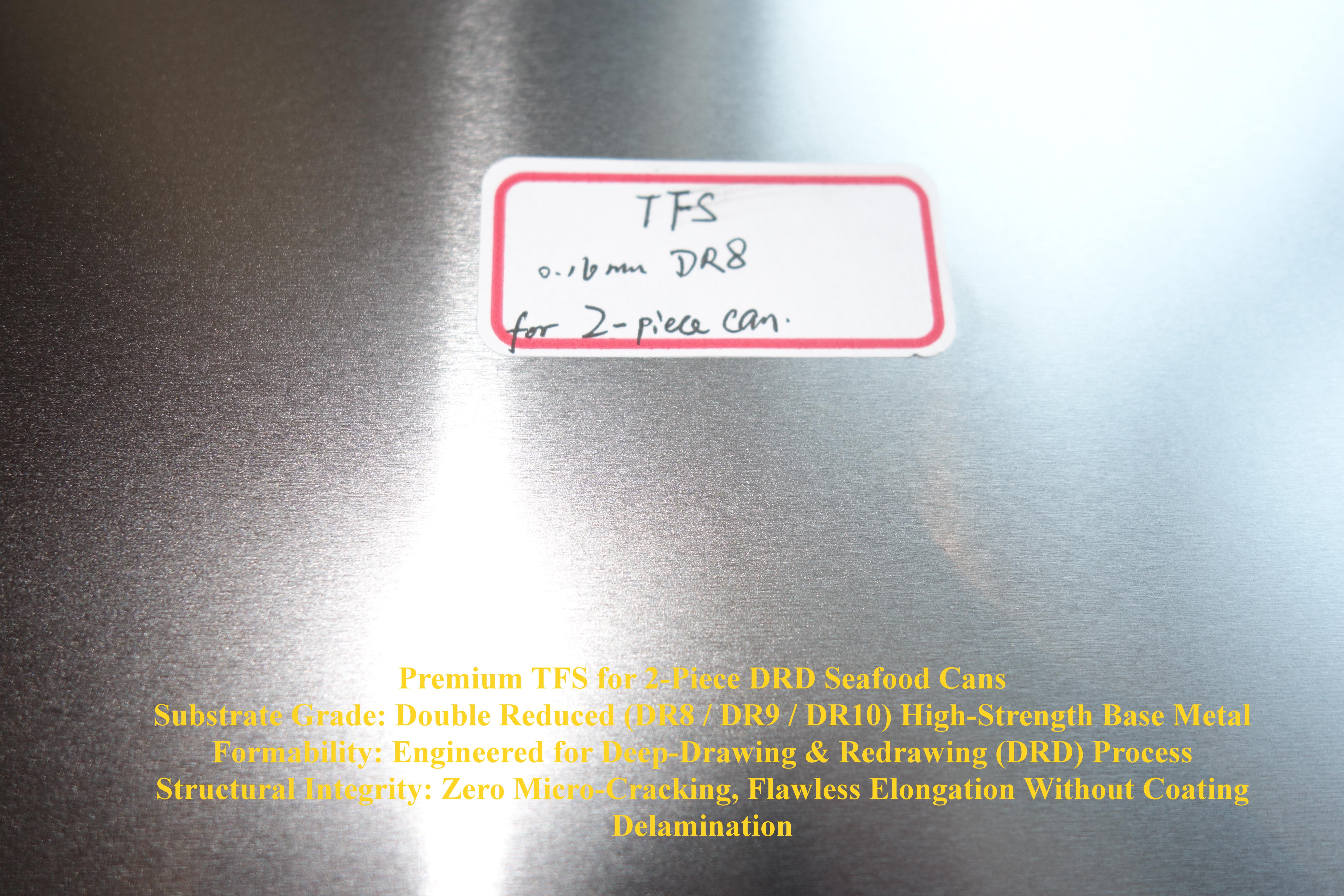
The clearest current example is two-piece DRD fish cans. A BPA-free internal sulfur-resistant aluminum paste coating is applied at 8–12 g/m² (heavier coats available on request) on 0.14–0.16 mm TFS in DR8, DR9 or DR10 temper. The system is engineered for retort sterilization at 121°C for 60 to 90 minutes, for oil and brine resistance, and for zero discoloration or sulfur staining after retort — the failure mode that sulfur-bearing seafood proteins cause in under-specified cans.
Layer 3 — product form: coil, precision slit strip or sheet
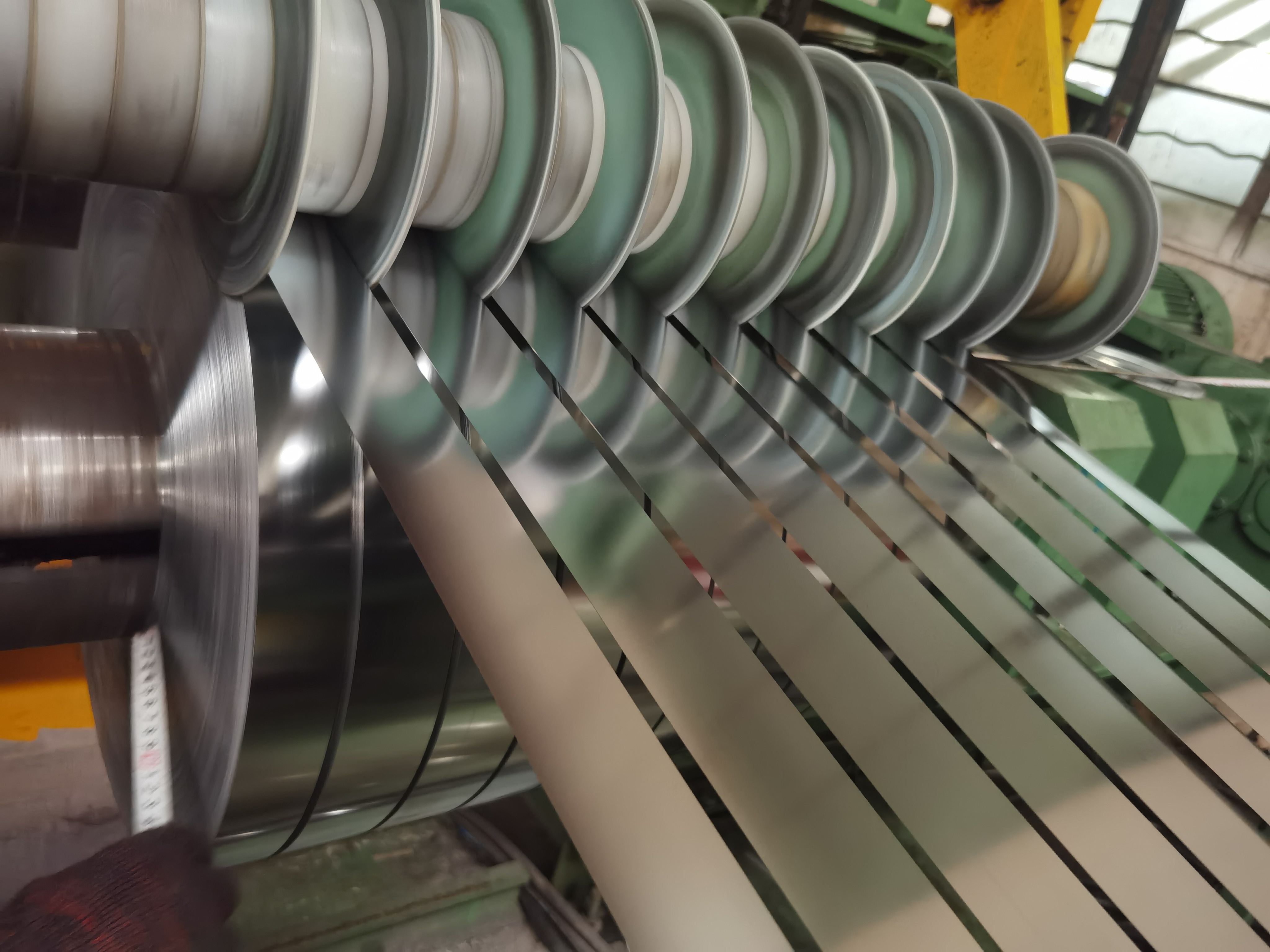
Form is a production decision with a specification attached. Coil suits continuous lines with in-house slitting or blanking. Precision slit strip is specified when the material feeds a press directly: widths from 4.0 mm to 1050 mm, burr controlled to ≤0.05 mm, tight slitting tolerance (quoted at ±0.02 mm on the custom programme and ±0.05 mm on several standard slit products), and thickness tolerance down to ±0.005 mm on specified grades. Sheet suits lithography and cut-to-size blank feeding.
Slit quality deserves equal weight to gauge. Joints, notches, edge waves, overlapping wraps and rust spots are the defects that stop a progressive die, and ≤0.05 mm burr plus oil-sprayed slit edges is what keeps high-humidity shipments usable on arrival.
Coatings: what each system is actually for
Coating selection follows the function, not the colour.
Internal food-contact coatings. Milky white coated tinplate sheet is specified for meat cans, where the coating separates the product from the metal and provides a consistent, printable internal appearance. Sulfur-resistant aluminum paste on TFS is specified for fish and seafood, where sulfur staining and retort resistance dominate.
Pre-painted deep-drawing coatings. Gold pre-painted tinplate strip at 0.14–0.15 mm, supplied in T1, DR7, DR7.5, DR8, DR9, DR10 or TH520 with tin coatings of 1.1/1.1, 2.2/2.2 or 2.8/2.8 g/m², is built for deep drawing with anti-peeling performance. In a documented case, a candle-lid producer running automated progressive-die deep drawing on this material reported zero gold lacquer cracking or peeling, zero die jams from joint-free coils, and roughly 35% lower tool wear from ±0.005 mm thickness tolerance and ≤0.05 mm burr over more than ten years of supply.
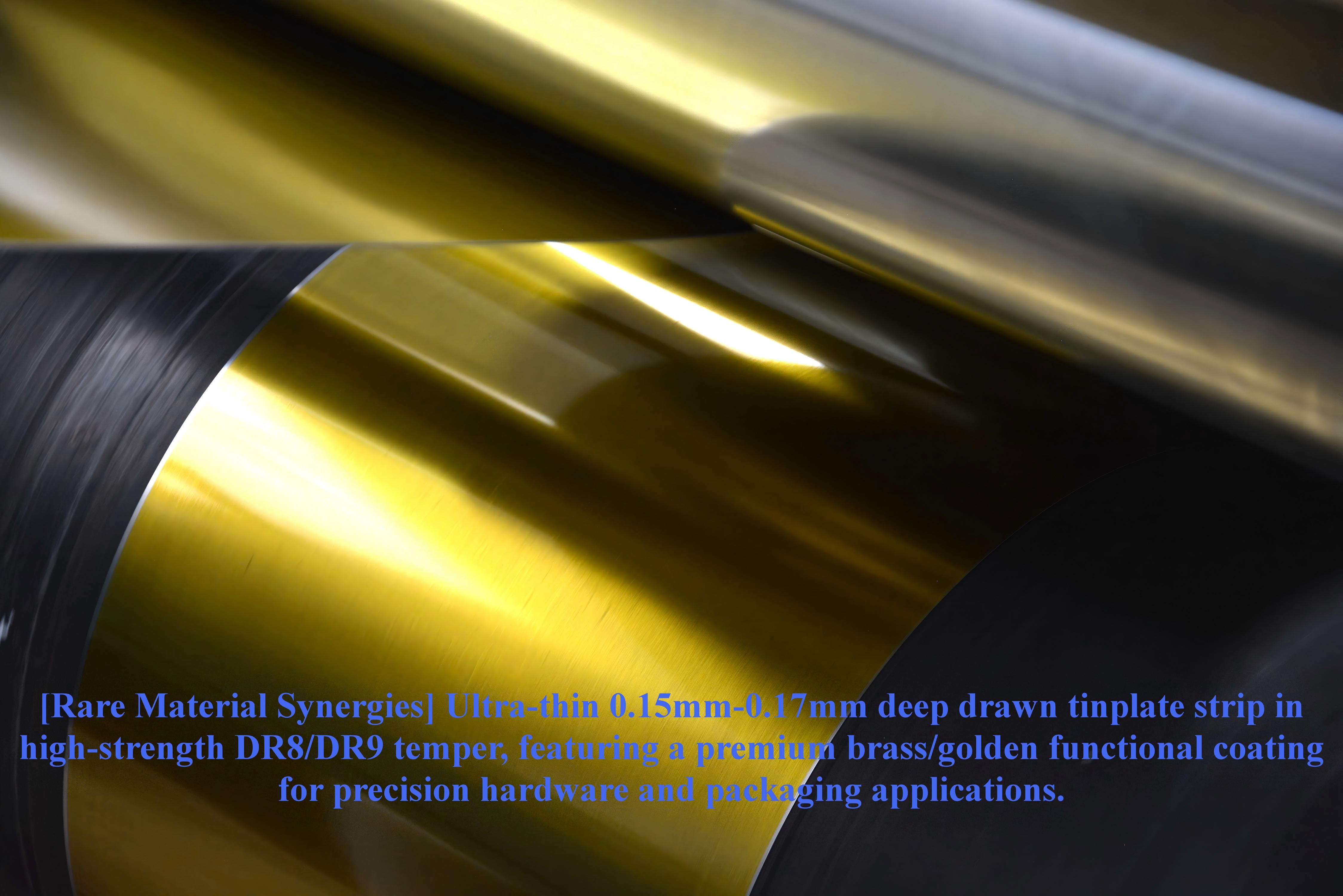
Decorative and functional exterior coatings. Bronze and copper coatings on ETP base at 0.15–0.30 mm, hardened to HV120–HV180, are used as a cost-saving substitute for copper-plated steel in stamping and premium packaging; the coating is rated to withstand 120°C for five hours with zero peeling or blistering. Anti-fingerprint mirror finishes at 0.20–0.50 mm in T2, T2.5, T52, T55 or T57, with an oleophobic nano treatment on one or both sides, are positioned as a substitute for SUS201 and SUS410 in decorative hardware, appliance fascias and lighting components.

Step-by-Step Gauge and Coating Selection
Use Cases Mapped to Specification
Seafood cans. TFS, 0.14–0.16 mm, DR8–DR10, BPA-free aluminum paste internal coating at 8–12 g/m², retort at 121°C for 60–90 minutes. Tuna, sardines and salmon are the reference applications.
Meat cans. ETP with a milky white internal coating, where the coating carries the food-contact function and the tin layer contributes to the corrosion margin.
Deep-drawn lids and drawn shells. Gold pre-painted strip at 0.14–0.15 mm in DR8, DR9, DR10 or TH520, with anti-peeling adhesion as the acceptance criterion rather than colour match.
Decorative hardware, cosmetics and appliances. Bronze, copper or mirror-coated strip in 0.17–0.50 mm, selected where a stainless or plated look is required at a lower material cost.
Automotive and industrial stamping. Filter-grade slit strip at 0.21, 0.24, 0.25 and 0.30 mm with ±0.005 mm thickness tolerance and ≤0.05 mm burr, supplied joint-free for continuous progressive-die feeding.
Comparison Table: ETP vs. TFS
| Attribute | ETP (Electrolytic Tinplate) | TFS (Tin Free Steel / ECCS) |
|---|---|---|
| Metallic coating | Electrolytic tin layer, quoted as designations such as E2.8/2.8, E5.6/5.6 or E8.4/8.4 | No tin layer; protection comes from surface passivation plus the applied lacquer |
| Role of the lacquer | Optional or application-specific; the tin layer contributes corrosion resistance | Mandatory; the lacquer is the barrier |
| Typical internal systems | Milky white coating for meat cans | BPA-free sulfur-resistant aluminum paste at 8–12 g/m² for fish cans |
| Grades offered | T1–T5 and DR7–DR10, with TH520/TH550/TH620 and BA/CA finishes | DR8, DR9 and DR10 for DRD fish cans; TFS also supplied in DDQ/DR strip grades |
| Reference gauge | 0.14–0.55 mm coated window; 0.08–6.0 mm custom ranges | 0.14–0.16 mm for the BPA-free fish-can specification |
| Forms | Coil, precision slit strip (4.0–1050 mm), sheet | Coil, precision slit strip, sheet |
| Best fit | Meat cans, decorative and pre-painted strip, hardware, general deep drawing | Lacquered seafood and DRD packs where no tin layer is required |
| Verification documents | MTC EN 10204 3.1, SGS heavy-metal test report, BV ISO9001:2015 | Same document set, with the internal coating specification added |
Gauge Reference by Application
| Application | Typical gauge | Grade / coating note |
|---|---|---|
| Two-piece DRD fish cans (TFS) | 0.14–0.16 mm | DR8–DR10; BPA-free aluminum paste 8–12 g/m²; retort 121°C |
| Gold pre-painted deep drawing | 0.14–0.15 mm | T1, DR7, DR7.5, DR8, DR9, DR10, TH520; anti-peeling coating |
| Decorative ultra-thin strip | 0.17 mm | T2 temper; brass, gold, matte black or bright black coating |
| General packaging and hardware | 0.18, 0.19, 0.20 mm | T1, T2, T2.5, T3; single or double-sided coating |
| Filter and precision stamping | 0.21–0.30 mm | T1 and T3–T5; ±0.005 mm thickness tolerance |
| Heavier hardware, caps, drawn parts | 0.40, 0.50, 0.55 mm | T2, T2.5, T3; anti-rust edge treatment |
| Custom programmes | 0.08–6.0 mm | Slitting tolerance ±0.02 mm; temper from soft to full hard |
Frequently Asked Questions
1. What documents should accompany a RoHS-compliant coated tinplate order?
Ask for the test report, not the label. A product-level RoHS report should identify the tested item — for example, an SGS report numbered CZXHL25001691201, issued on 18 August 2025 for copper colorful tinplate at 0.23 mm thickness, tested against RoHS 2.0 (2011/65/EU and (EU) 2015/863) using the IEC 62321 series methods. The factory system should be separately evidenced: BV ISO9001:2015 certificate CN058611, valid from 23 December 2022 to 22 December 2028. Per shipment, MTC EN 10204 3.1 provides batch traceability, and third-party inspection through SGS, BV or TÜV can be added. Because a RoHS report is scoped to a specific product and thickness, always check whether the report covers the exact item being purchased.
2. Can ETP and TFS be supplied in coil, precision slit strip and sheet from one source?
Yes. A single programme can cover ETP and TFS in coil, slit strip and sheet form, with grades including T1, T2, T3, T4 and T5 and hardness designations TH520, TH550, TH620, DR8, DR9 and DR10 in BA or CA finish. Standard coated tinplate thickness is 0.14–0.55 mm, custom thickness ranges extend to 0.08–6.0 mm, slit widths run from 4.0 mm to 1050 mm, and slitting tolerance is quoted at ±0.02 mm with burr at ≤0.05 mm.
3. What drives the cost of a coated tinplate strip?
Four variables dominate: gauge and temper (thin, high-strength double-reduced grades carry a different cost base than soft T2), coating chemistry and whether it is applied to one or both sides (a BPA-free sulfur-resistant aluminum paste at 8–12 g/m² is a different cost item from a decorative coat), slitting width and tolerance (narrow widths with ±0.02 mm tolerance consume more processing), and documentation. Substitution economics are usually larger than unit-price differences: mirror-finish pre-coated strip is positioned at more than 20% material cost saving against brass/gold anodized or electroplated stainless sheet, and pre-coated copper-look strip at more than 50% saving against conventional copper electroplating, mainly by removing a post-stamping plating step.
4. How should a coating be validated before mass production?
Test the coating under the conditions it will actually meet. For deep-drawing grades, cross-cut adhesion and draw trials confirm anti-peeling behaviour before the flat sheet is judged. For fish-can TFS, the aluminum paste system should be checked after retort at 121°C for 60–90 minutes for adhesion, discoloration and sulfur staining. For decorative coatings on stamped parts, the heat exposure stated for the system (for example 120°C for five hours at zero peeling and zero blistering on bronze coatings) is a useful screening point. A trial quantity plus the corresponding MTC closes the loop.
5. What MOQ and lead time apply to custom slit or coated tinplate?
Orders are typically quoted at an MOQ of 2–3 tons depending on size, with lead times of 5–30 days depending on specification, against monthly processing capacity of roughly 1,200 tons. Custom coating development and precision slitting are handled in-house, so gauge, width, coating and packaging are confirmed on the quotation rather than assumed. To move from specification to a firm offer, send the substrate, gauge, temper, coating, width, burr limit and target pack format; YOUNGSON METAL will respond with a quotation and a trial quantity for validation at info@youngsonmetal.com or WhatsApp 0086-13594107385.
Conclusion
Tinplate selection becomes manageable once it is treated as three decisions rather than one. ETP or TFS determines where corrosion protection comes from. The coating system — milky white for meat cans, BPA-free sulfur-resistant aluminum paste for fish cans, gold pre-paint for deep drawing, bronze or mirror for appearance — determines whether the pack or the part survives its service conditions. Gauge and temper, within a 0.14–0.55 mm coated window or 0.08–6.0 mm custom range, determine whether the material forms without cracking and without wearing the tooling. Documentation then proves that all three were delivered as specified.
Buyers who define those three layers before requesting a price comparison get quotations that can actually be compared — and cans, lids and stamped parts that behave the way the specification promised.
Next step: catalogue, sample and quotation
Download the full YOUNGSON METAL product catalogue with grades, gauges, coating options and packaging specifications: Chongqing Youngson Metal Products catalogue (PDF).
Website: www.youngsonmetal.com | Email: info@youngsonmetal.com | Tel: 0086-23-62566629

Have Questions or Need More Details?
Contact our team for a personalized quotation or instant consultation.
Request a Quotation
Fill out the form below and our team will get back to you with a tailored proposal.
WhatsApp Direct Chat
Prefer to chat in real-time? Message us on WhatsApp for instant assistance & quick answers.
- Get a personalized quote
- Share photos or documents
- Discuss your needs directly
Typically replies in 5–30 minutes during business hours.