
TINPLATE Slitting Tolerance ±0.02 mm: A Technical Guide for High-Speed Fuel Filter Stamping
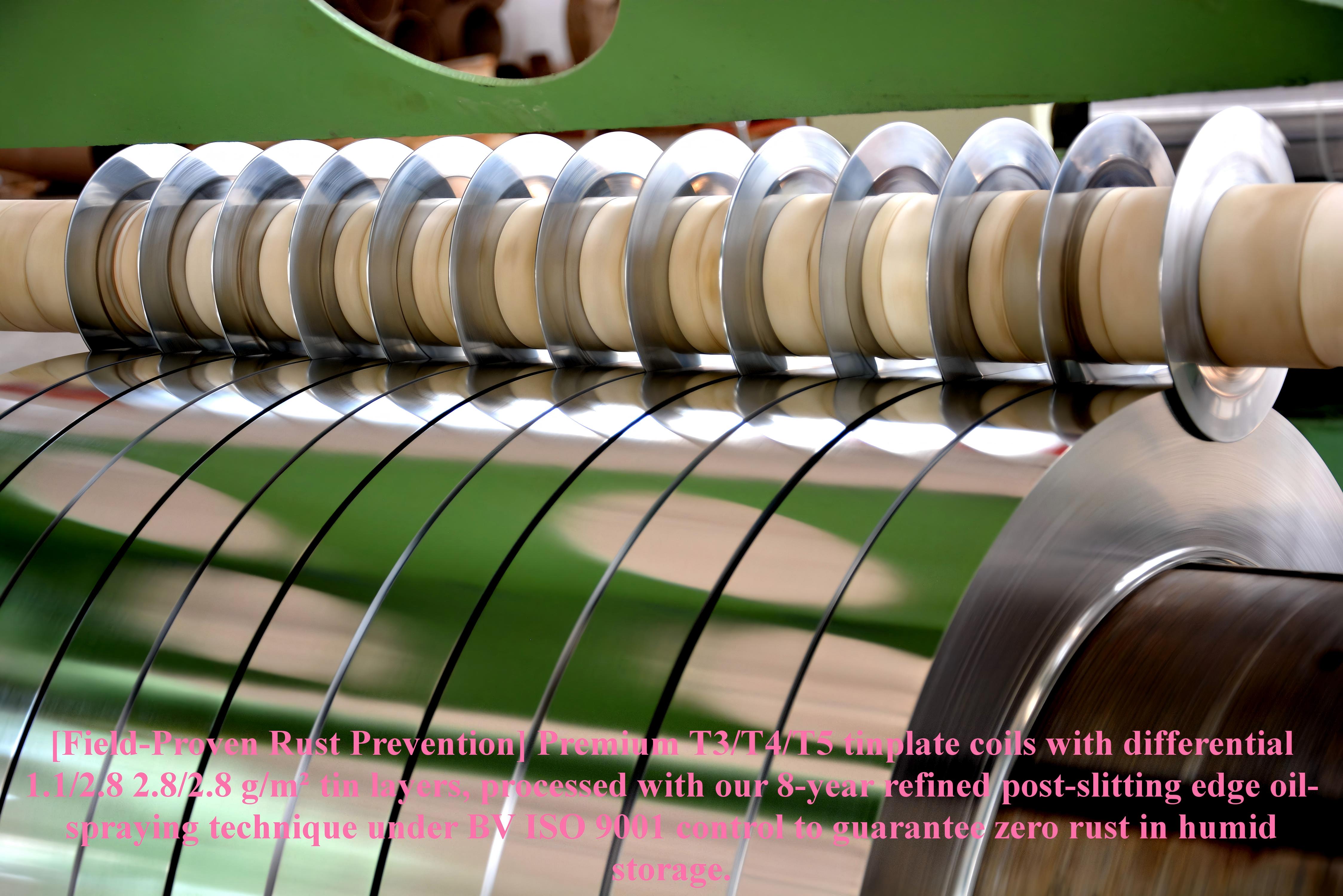
Direct answer: a TINPLATE slitting tolerance of ±0.02 mm is a stated precision-slitting capability that is specified project by project, and it is what keeps a high-speed fuel filter stamping line stable. When strip arrives with a repeatable width, a controlled edge burr and a coil that uncoils without joints, camber or wave edges, the progressive die stays aligned, the feeder does not jam, and scrap stays low. Chongqing Youngson Metal Products Co., Ltd. (YOUNGSON METAL), a BV ISO 9001:2015-certified slitting, cold rolling and coating manufacturer founded in 2016 in Chongqing, China, supplies precision slit TINPLATE (ETP) and TFS strip for fuel filter perforated tubes, inner cores, outer shells and end caps, with stated thickness tolerance of ±0.005 mm, edge burr ≤0.05 mm, and 100% in-house inspection backed by MTC EN 10204 3.1 documentation.
This guide is written for filter plant engineers, tooling engineers and procurement managers who are comparing slitted TINPLATE strip for high-speed stamping. It sets out the tolerance stack that matters, the parameters that must be written into an RFQ, and the verification documents to request before the first coil is loaded onto the press.
Problem Definition: why strip tolerance decides filter stamping yield
Fuel filter components such as perforated core tubes, inner cores, outer shells and end caps are produced on high-speed progressive and multi-stage transfer dies. In that process the strip itself is a tooling interface, not just raw material. Four strip variables control whether the line runs at rate or stops:
- Width and gauge consistency. If the slit width drifts, the pilot pins no longer centre the strip on every stroke. If the gauge drifts, the die clearance changes and the cut edge quality changes with it. Youngson's filter-grade core strip is stated at ±0.005 mm thickness tolerance, which is the band that keeps die clearance predictable across a full coil.
- Edge burr. Burr height is a direct die-wear and part-quality factor. Youngson controls edge burr to ≤0.05 mm on precision slit strip, and the same figure appears across its filter-grade and burr-free product datasheets.
- Coil integrity. Joints, notches, wave edges, overlap bands and telescoping damage all cause unplanned press stops. Youngson applies a “5-ZERO” screening standard on slitted material: zero joints, zero notches, zero wavy edges, zero overlap ribbons and zero rust spots.
- Edge corrosion. Slitting exposes bare steel on the cut edge. Without protection, filter parts can show edge rust after humid storage or marine transit, and that rust becomes a cleanliness problem inside a filter assembly. Youngson sprays anti-rust oil onto the slit edges for humid-climate protection as a standard step.
The practical consequence is straightforward: a tolerance that is written loosely on the purchase order becomes scrap, die maintenance and unplanned downtime at the press. A tolerance that is written precisely and verified with documentation becomes a controllable input.
Industry Background: TINPLATE as a filter and hardware substrate
TINPLATE (electrolytic tinplate, ETP) and TFS (tin free steel, also called ECCS) remain widely used substrates where a combination of formability, corrosion resistance, solderability and surface quality is required. Industry market research places the global tinplate market value at USD 31.98 billion in 2025, with Asia Pacific holding a 39.2% share of that market in the same year. Trade data for the July 2024 to June 2025 window records China as the world’s largest tinplate exporter with 3,137 shipments, which is why Chinese slitting and coating plants remain a practical sourcing option for automotive filter and hardware programmes.
On the material side, the industry reference range for DR8 double-reduced tinplate is a Rockwell HR30Tm of 69–75, reflecting the use of double-reduced grades where higher strength at thinner gauge is needed. Filter and stamping programmes therefore typically choose between softer single-reduced tempers for drawing and higher-strength double-reduced tempers for stiffness-critical parts.
For fuel filter stamping specifically, the substrate has to satisfy three demands at once: it must form without cracking or earing, it must hold dimension stroke after stroke, and it must stay clean and rust-free from the slitting line to the press. That combination is why the slitting step — not only the steel grade — is the parameter buyers should audit.
Detailed Solution: what ±0.02 mm slitting tolerance means in practice
Youngson Metal operates precision slitting, cold rolling and cut-to-length processing in-house, with a stated monthly capacity of about 1,200 tons and an annual processed quantity exceeding 10,000 tons. Its product portfolio is divided into commercial grade and deep drawn grade TINPLATE and TFS with lithography, coil coating and laminated PET film, plus pre-painted steel and stainless steel for other programmes. Around 70% of output is exported to global markets.
On tolerance, the distinction between line capability and a published datasheet figure matters:
- Stated customization capability: width and slitting tolerance of ±0.02 mm, across a material thickness customization range of 0.08–6.0 mm and a strip slitting width range of 4.0–1,050 mm.
- Published filter-grade datasheet: the automotive filter core material strip is listed at 0.21 mm, 0.24 mm, 0.25 mm and 0.30 mm with thickness tolerance ±0.005 mm, width tolerance within ±0.05 mm and edge burr ≤0.05 mm.
In other words, ±0.02 mm is a precision capability that should be confirmed against the specific drawing, coil width and temper rather than assumed for every SKU. The correct procurement action is to state the required width band, the datum (strip centre or edge), the measurement method and the sampling frequency in the RFQ, and to require the mill test certificate to report the measured width values.
1. Thickness range and gauge control
Youngson’s TINPLATE and TFS strip products are published in a thickness range of 0.14–0.55 mm, with cross-product customization capability from 0.08 mm to 6.0 mm across tinplate, pre-painted steel, cold rolled steel, galvanized, galvalume, Zn-Al-Mg, stainless and aluminium substrates. For fuel filter components, the working range is narrower and typically sits between 0.20 mm and 0.30 mm. Thickness tolerance is stated at ±0.005 mm on the filter core strip series and on the DDQ/EDDQ deep-drawing series.
2. Temper and hardness selection
Filter components fall into two forming groups. Deep-drawn outer shells and end caps need soft, high-ductility material: the DDQ and EDDQ series is published with a T1 temper at Rockwell HR30T 49±3, in 0.20–0.50 mm, and is described as engineered for automotive filter outer shells and multi-stage drawn hardware. Core tubes and inner cores, which are stamped and formed rather than severely drawn, are published with T3, T4, T5 and T1 temper options. For higher-strength programmes, Youngson also lists T2, T2.5, T3, T5, DR7, DR8, DR9, DR10 and TH520/TH550/TH620 designations across its slit strip range.
3. Surface finish
Published surface finish options include bright and stone finishes, together with BA and CA designations and 2B, BA and No.4 finishes across the wider steel strip range. For internal filter parts, a bright, uniform finish supports visual inspection of the strip surface; for visible or decorative hardware stampings, matte and mirror finishes are also offered with anti-fingerprint topcoat options.
4. Coating options
Coating is not usually required on internal filter cores, but it is specified when the stamped part is visible in service or when a pre-painted substrate shortens downstream processing. Youngson’s eco-friendly coating line offers single-sided or double-sided lacquer, brass, black, red, grey, blue and laser colour finishes with anti-fingerprint options, on ETP, TFS/ECCS, galvanized and ZAM substrates. Tin coating masses are published as 1.1/1.1, 2.2/2.2 and 2.8/2.8 g/m², with differential coating options such as 1.1/2.8 g/m² used where an asymmetric corrosion barrier is required.
5. Slit-edge protection and coil structure
Every precision slit strip is delivered with oil-sprayed anti-rust treatment on the cut edges, engineered for humid and tropical climates and for long sea transit. Coil structure is controlled to joint-free, camber-free, tight-tension winding with zero telescoping, and inner diameters are available in 160 mm, 200 mm, 300 mm, 400 mm and 500 mm so that the coil matches the existing uncoiler and feeder setup.
6. Inspection and documentation
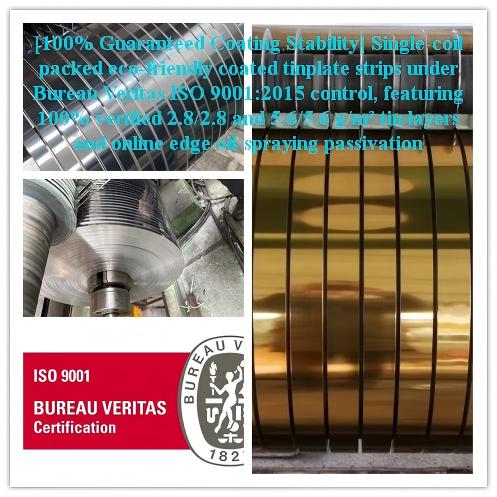
Quality control is 100% in-house and covers thickness, coating mass, tensile strength, T-bend, salt spray and surface roughness. Each batch is supported by an MTC EN 10204 3.1, and third-party inspection by SGS, BV or TÜV can be arranged. The quality system is audited by Bureau Veritas under ISO 9001:2015, certificate number CN058611, issued 23 December 2022 and valid to 22 December 2028, with a stated scope covering mild steel, automotive steel and pre-painted steel. Compliance documentation also includes an SGS RoHS 2.0 certificate numbered CZXHL25001691201, issued 18 August 2025 under directives 2011/65/EU and (EU) 2015/863 for the global market. Certified EPD and CFP (ISO 14067) carbon footprint documentation is available for buyers who need EU CBAM-related emissions data.
Procurement baseline for filter strip projects
- MOQ: 2–3 tons, as per sizes
- Lead time: 5–30 days, as per sizes
- Monthly capacity: about 1,200 tons
- Inspection: 100% in-house plus MTC EN 10204 3.1, third-party SGS/BV/TÜV on request
Step-by-Step Breakdown: specifying slitted TINPLATE for a filter stamping programme
- Define the stamped part and its forming severity. Separate severely drawn parts (outer shells, end caps) from cut-and-formed parts (perforated tubes, inner cores). This determines whether a DDQ/EDDQ grade is required or whether a standard temper will hold.
- Fix the gauge and its tolerance. For filter core strip, Youngson’s published thickness window is 0.21–0.30 mm at ±0.005 mm; for drawn shells the DDQ/EDDQ series covers 0.20–0.50 mm. State the gauge in the RFQ together with the measurement method.
- Select the temper. T1 at HR30T 49±3 for deep drawing; T3, T4 or T5 where stiffness and stamping stability dominate; DR grades where higher tensile strength is needed. Confirm the temper against a forming trial rather than on paper alone.
- Set the tin coating mass. Filter cores are commonly run at 1.1/2.8 or 2.8/2.8 g/m². Differential coating is available where only one face needs the heavier barrier.
- Write the slitting specification precisely. Give the nominal width, the permitted band, the datum, and the burr limit (≤0.05 mm on precision slit strip). Where the press requires tighter width control, request the ±0.02 mm precision slitting capability explicitly and confirm feasibility for that width and gauge.
- Specify edge protection and coil build. Confirm anti-rust oil on slit edges, joint-free coils, and the coil inner diameter (160/200/300/400/500 mm) that matches your uncoiler.
- Agree the documentation pack. Require MTC EN 10204 3.1 per batch, and confirm whether SGS, BV or TÜV third-party inspection is needed for the first shipment or for periodic audits.
- Run a press trial before volume release. Verify burr height, strip tracking, die noise, scrap rate and part dimension over a full coil, and record the measured width at start, middle and end of coil.
- Lock the supply parameters into a specification sheet. Once the trial passes, freeze gauge, temper, coating mass, width band, burr limit, edge treatment, coil ID and documentation into a single internal specification, and reference it in every PO.
Use Cases: where slitted TINPLATE strip is applied
Fuel filter perforated tubes and inner cores
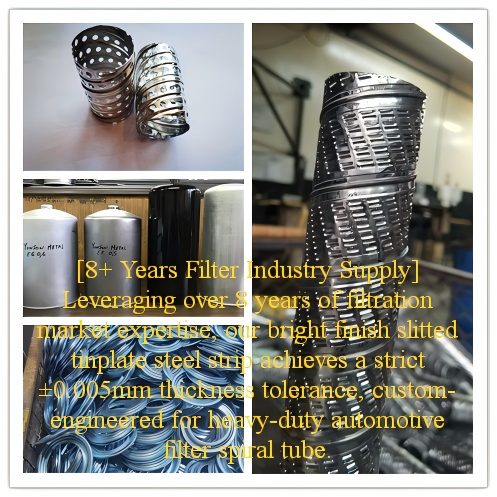
The automotive-grade filter core material strip is published in 0.21 mm, 0.24 mm, 0.25 mm and 0.30 mm with ±0.005 mm thickness tolerance and ≤0.05 mm edge burr, and is explicitly described as developed for high-speed metal stamping of fuel filter components and perforated core tube fabrication. The supplier states more than eight years of dedicated development in the global filter component supply chain.
Filter outer shells and end caps
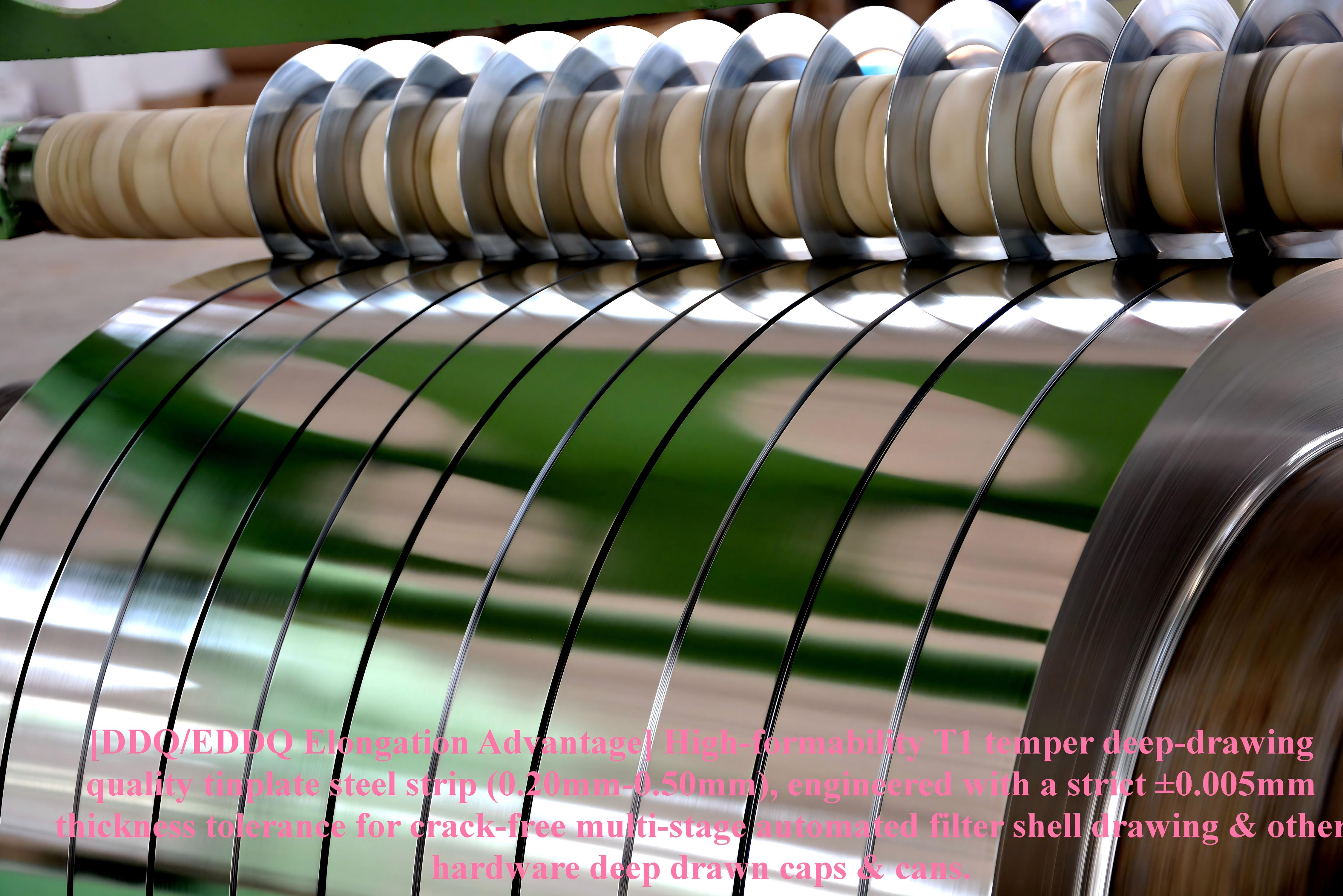
For drawn shells and end caps, the DDQ/EDDQ T1 series covers 0.20–0.50 mm with the same ±0.005 mm and ≤0.05 mm limits, and carries the same 5-ZERO slit quality screening for uninterrupted automated tool feeding.
High-speed progressive stamping, verified in production
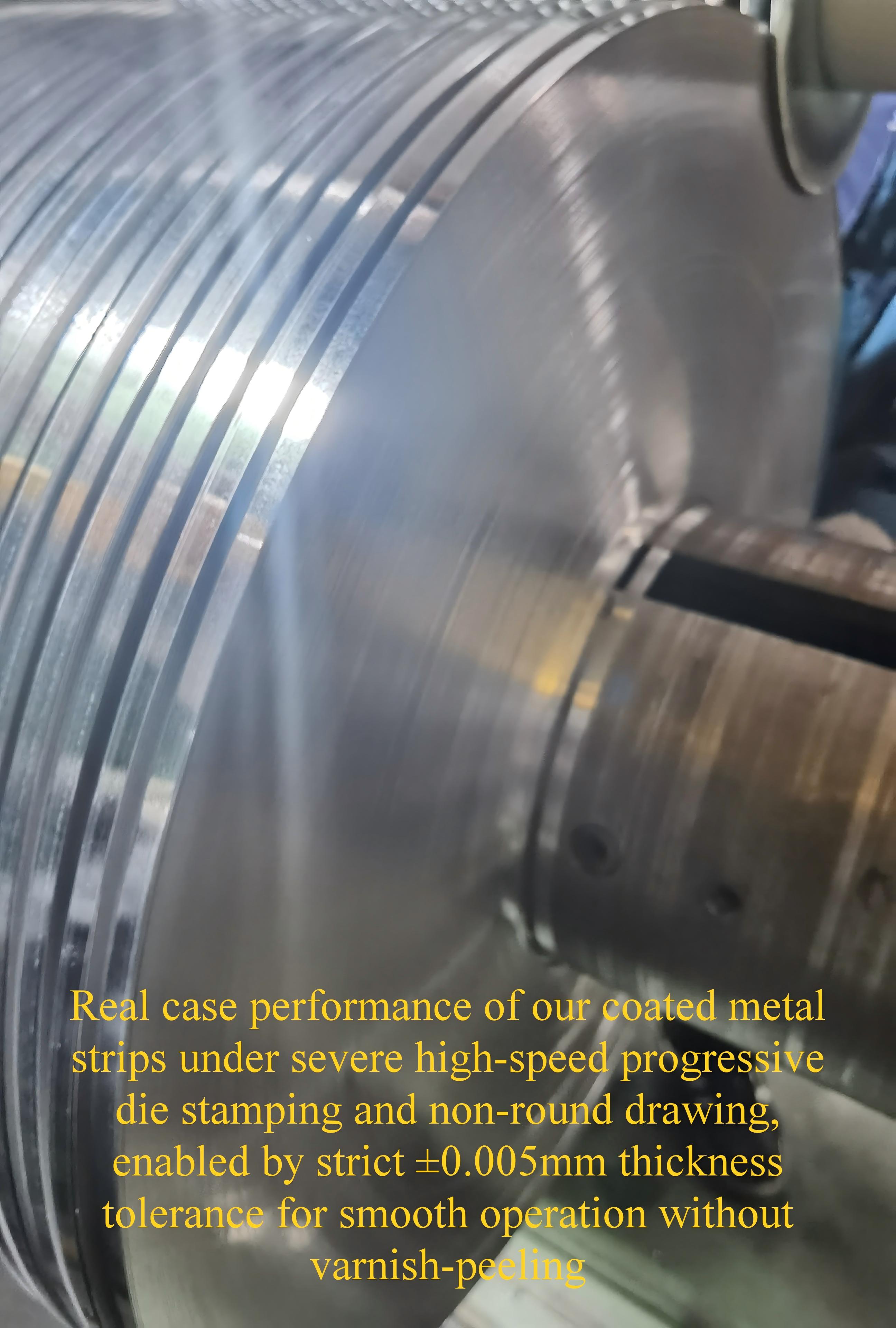
A high-speed hardware stamping plant and can-maker supplied with precision slit strips and multi-colour coated coils reported zero-defect continuous stamping with 0% coating delamination or foil bursting during deep drawing, and a 35% extension in progressive die tool lifespan attributed to the ±0.005 mm thickness tolerance and burr-free edges. Volume is described as 6,000+ tons annually over a 3+ year supply relationship.
Narrow-width micro-stamping components
Where filter or hardware assemblies need very narrow strip, Youngson publishes a precision narrow strip series from 4.0 mm to 100 mm width in 0.10–0.60 mm thickness, with ±0.05 mm width tolerance, ≤0.05 mm burr and rare small inner diameters of 160 mm and 200 mm, described as jointless, camber-free and tight-tension wound for zero-downtime continuous high-speed stamping.
Comparison Table: slitted TINPLATE strip options for filter and hardware stamping
The three columns below compare published datasheet values from Youngson Metal’s filter-grade, deep-drawing and burr-free precision strip series. A dash means the value is not stated in the referenced product datasheet and should be confirmed in the RFQ.
| Specification | Filter-grade core strip | DDQ / EDDQ drawn strip | Burr-free precision strip |
|---|---|---|---|
| Thickness range | 0.21 / 0.24 / 0.25 / 0.30 mm | 0.20–0.50 mm | 0.14–0.55 mm |
| Thickness tolerance | ±0.005 mm | ±0.005 mm | ±0.005 mm |
| Width range | — | — | 4.0–1,050 mm |
| Width / slitting tolerance | within ±0.05 mm | within ±0.05 mm | ±0.05 mm |
| Edge burr | ≤0.05 mm | ≤0.05 mm | ≤0.05 mm |
| Tin coating mass | 1.1/2.8 or 2.8/2.8 g/m² | 2.8/2.8 g/m² | 2.8/2.8 g/m² |
| Temper / hardness | T3, T4, T5, T1 | T1, HR30T 49±3 | T1, T2, T2.5, T3, T5, DR7, DR8 |
| Slit-edge protection | Anti-rust oil | Anti-rust oil | Oil-sprayed anti-rust |
| Documentation | BV ISO 9001 framework, batch-traceable MTC | BV ISO 9001 framework, batch-traceable MTC | BV-certified ISO 9001 quality system |
| Stated stamped parts | Filter perforated tubes and inner cores | Filter outer shells and end caps | Precision hardware and decorative stamping |
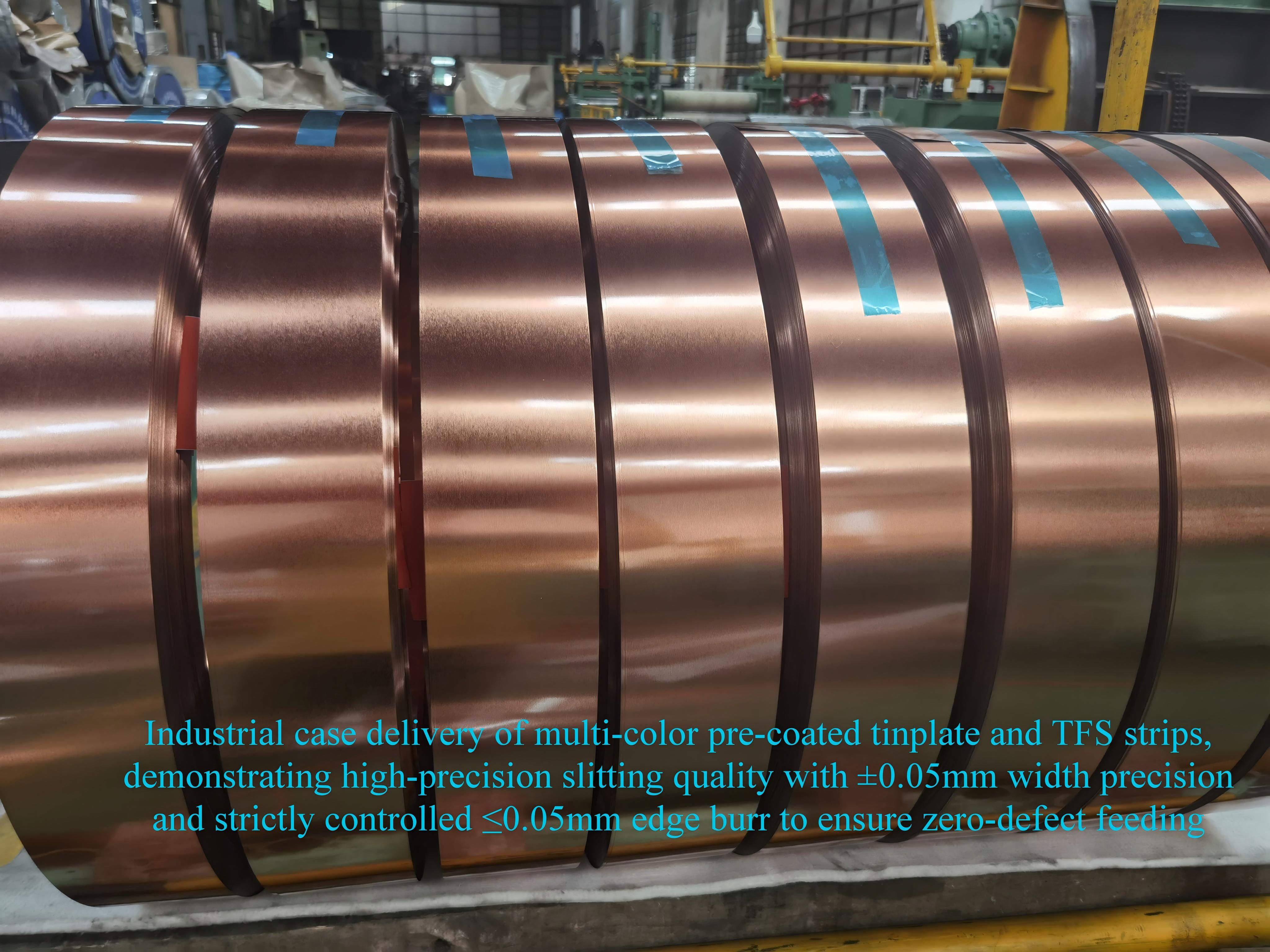
Note on tolerance: the ±0.02 mm width and slitting tolerance is listed as a customization capability of Youngson’s precision slitting lines. The product datasheets above state width tolerance within ±0.05 mm. Where a drawing requires the tighter band, specify it in the RFQ and confirm it against the actual width, gauge and temper before the order is placed.
FAQ
Which RoHS certification covers Youngson Metal’s coated tinplate strip?
Youngson Metal holds an SGS RoHS 2.0 certificate numbered CZXHL25001691201, issued on 18 August 2025 under directives 2011/65/EU and (EU) 2015/863, valid for the global market. The certificate’s stated scope is copper colourful tinplate at 0.23 mm thickness. The wider eco-friendly coated strip range is also documented as tested to SGS REACH and RoHS heavy-metal requirements, and the quality system is audited by Bureau Veritas under ISO 9001:2015 (certificate CN058611, valid to 22 December 2028, scope including automotive steel). Buyers should request the product-specific SGS report that matches their exact thickness, coating and colour, because certificate scope varies by SKU.
What thickness and slitting tolerances can be held for fuel filter stamping strip?
Published values for the automotive filter core strip are 0.21 mm, 0.24 mm, 0.25 mm and 0.30 mm with thickness tolerance ±0.005 mm, width tolerance within ±0.05 mm and edge burr ≤0.05 mm. The deep-drawing DDQ/EDDQ series covers 0.20–0.50 mm at the same ±0.005 mm thickness tolerance. Youngson’s stated customization capability for precision slitting is a width and slitting tolerance of ±0.02 mm, within a slitting width range of 4.0–1,050 mm and a TINPLATE strip thickness range of 0.14–0.55 mm (custom 0.08–6.0 mm across material grades). The tighter ±0.02 mm band is confirmed project by project against the required width, gauge and temper.
What is the minimum order quantity for precision slitted TINPLATE strip?
The stated MOQ is 2–3 tons, depending on the size and specification, with a monthly capacity of about 1,200 tons. MOQ is assessed together with width, gauge, temper and coating, because narrow slit widths and coated variants consume more line time per ton than plain wide strip. Every batch is covered by 100% in-house inspection of thickness, coating mass, tensile strength, T-bend, salt spray and surface roughness, plus an MTC EN 10204 3.1.
Can we run a sample before committing to a volume order?
Yes. The deep-drawing series is documented as including complimentary sample rolls or sheets for industrial press trialing, which allows a filter plant to verify burr height, strip tracking, die behaviour and part dimension on its own press before releasing volume. A practical trial also records measured width at the start, middle and end of the coil so that within-coil consistency is evidenced, not assumed. Sample requests can be sent to info@youngsonmetal.com or via WhatsApp on 0086-13594107385 with the drawing, gauge, temper and target width.
What is the typical lead time, and what shipping support is provided?
Stated lead time is 5–30 days, depending on size and specification. Material is packed for export with anti-rust protection and independent single-coil moisture-barrier packaging, and global ocean freight booking and tracking support is provided. Technical support covers metallurgical and slitting questions, third-party inspection by SGS, BV or TÜV can be coordinated on request, and a material quality claim receives a response within 24 hours. To move a filter strip project forward, the fastest route is to send your drawing and required tolerance band for a quotation and a trial sample.
Conclusion
A ±0.02 mm slitting tolerance is not a marketing figure — it is an engineering target that only pays off when it is matched to the right gauge, temper, coating and edge condition for the specific stamped part. For fuel filter component stamping, the controllable specification set is: thickness at ±0.005 mm, slit width confirmed against the drawing (up to ±0.02 mm precision capability where feasible), edge burr ≤0.05 mm, joint-free and camber-free coils, oil-sprayed anti-rust edges, and a documentation pack built on MTC EN 10204 3.1 with BV ISO 9001:2015 system certification and SGS RoHS 2.0 compliance evidence.
Chongqing Youngson Metal Products Co., Ltd. supplies precision slit TINPLATE and TFS strip from Chongqing, China, with in-house slitting, cold rolling, cut-to-length and coating lines, a stated MOQ of 2–3 tons and a lead time of 5–30 days. Buyers evaluating filter strip suppliers can review the product range at youngsonmetal.com, read technical updates on the YOUNGSON METAL blog, download the full product catalogue (PDF), or send a drawing and tolerance requirement to info@youngsonmetal.com to request a quotation and press-trial sample.
Have Questions or Need More Details?
Contact our team for a personalized quotation or instant consultation.
Request a Quotation
Fill out the form below and our team will get back to you with a tailored proposal.
WhatsApp Direct Chat
Prefer to chat in real-time? Message us on WhatsApp for instant assistance & quick answers.
- Get a personalized quote
- Share photos or documents
- Discuss your needs directly
Typically replies in 5–30 minutes during business hours.