Tinplate Partnership FAQ: MOQ, Lead Times, Quality Inspection & After-Sales
Tinplate Partnership FAQ: MOQ, Lead Times, Quality Inspection & After-Sales
Quick answers for buyers screening a TINPLATE partner: minimum order quantity is 2–3 tons depending on sizes; typical production lead time is 5–30 days depending on sizes; every shipment is covered by 100% in-house quality inspection with an MTC EN 10204 3.1; third-party inspection through SGS, BV or TÜV can be arranged; customization covers material grade, thickness from 0.08 mm to 6.0 mm, slitting tolerance to ±0.02 mm, zinc coating from 30 g/m² to 600 g/m², surface finish and temper; and after-sales support includes metallurgical and slitting technical support plus EU CBAM carbon emission data reporting.
Most suppliers will tell a buyer that tinplate is tinplate. It is not — and the difference becomes visible on the customer's own production line, months after the purchase order was signed. A can body line or a progressive stamping press is tooled around one specific gauge, temper, coating mass and slit width, and it expects the same material next quarter and next year.
That is exactly why buyers in the Research and Evaluation stage stop asking only about price per ton and start asking five operational questions: how small can the first order be, how long until it ships, who inspects it before it leaves the plant, how far can the specification be customized, and who supports the buyer after the container is unloaded. This article answers those questions with documented values rather than adjectives.
Chongqing Youngson Metal Products Co., Ltd. — the manufacturer behind the YOUNGSON METAL brand — is a metal surface processing, slitting and supply company founded in 2016 in Chongqing, China. It is certified to BV ISO 9001:2015, operates its own coating lines and precision slitting machines, and processes more than 10,000 tons of metal annually, with roughly 70% of that output exported to global markets.
Why These Five Questions Decide a Tinplate Partnership
A tinplate relationship fails for predictable reasons, and almost none of them are about the headline price. They are about specification drift: a coating mass that quietly moves, a slit edge that burrs and jams a progressive die, a gauge tolerance that shifts enough to change draw depth, a coil that arrives with a rusty edge after six weeks at sea, or a batch that cannot be traced back when a customer asks for documentation.
The technical baseline is already defined by industry standards. Standard tinplate specifications (SPTE and ECCS) are expected to comply with frameworks such as ASTM A623 or EN 10202, which cover temper grades from T1 to T5 and DR7 to DR9. On top of that, tinplate used for food contact — particularly fish and meat cans — must meet RoHS requirements and coating requirements such as FDA 21 CFR 175.300.
So the real evaluation question is not whether a supplier can produce tinplate. It is whether the supplier can repeat a documented specification, prove it with batch-level evidence, and keep supplying it after the first order. MOQ, lead time, inspection depth and after-sales support are simply the four measurable answers to that question.
Industry Background: A Market That Rewards Documented Supply
The commercial context makes disciplined supply partners more valuable, not less. The global tinplate market was valued at USD 14.59 billion in 2023 and is projected to reach USD 19.38 billion by 2032, according to Fortune Business Insights. China remains a major source of that volume: tinplate exports under HS Code 721012 reached 1.4 million tons in the first three quarters of 2023, primarily driven by canned food packaging demand, based on data from the General Administration of Customs of China.
Downstream demand is steady rather than explosive. Grand View Research reports that the canned food packaging market, the primary end-user of sulfur-resistant lacquered tinplate, is growing at a CAGR of 3.9% through 2030. At the same time, Metal Packaging Europe notes that double cold reduced (DR) tinplate with thickness as low as 0.14–0.16 mm, for example DR8, is increasingly used for cost reduction and light-weighting in the metal packaging industry — a shift that puts more pressure on gauge, temper and burr control than conventional thicker material.
Light-weighting is the reason buyers ask about tolerances at the same time as they ask about price. When the substrate gets thinner, the acceptable error band gets narrower, and the supplier's inspection system becomes part of the customer's quality system. That is the environment in which a partnership FAQ stops being a formality and becomes a procurement document.
The Core Answers: MOQ, Lead Time, Inspection and After-Sales
Minimum Order Quantity: 2–3 Tons Depending on Sizes
For standard TINPLATE orders, the minimum order quantity is 2–3 tons as per sizes. The figure moves with what actually has to be set up on the line: a wide commercial-grade coil and a narrow, colour-coated slit strip do not consume the same amount of production effort. Where a program is specified through the precision slitting and pre-coated strip plant, orders can be quoted from 1 ton or as per specifications.
Capacity context matters here, because MOQ is only useful if the supplier can scale behind it. Youngson Metal's monthly processing capacity is approximately 1,200 tons, while the BV ISO 9001-certified boutique plant dedicated to high-precision steel strips and custom pre-coated matrix runs 500 to 1,000 tons per month. That combination allows a buyer to start with a validation-sized order and grow into a recurring monthly allocation without changing supplier.
Lead Time: 5–30 Days Depending on Sizes and Specification
Typical production lead time is 5–30 days as per sizes. For precision slitting and coated-strip programs, the commonly quoted band is 14 to 25 days, or as per specifications. The reason the range is wide rather than fixed is that lead time is driven by the specification package: base metal grade and gauge, coating type and film weight, slitting width, coil inner diameter, and whether the material requires custom coating development.
Buyers planning a multi-year supply relationship should therefore treat lead time as a per-specification value, not a company-wide promise. The practical approach is to request the quoted lead time together with the specification confirmation, so that a later size change does not silently reset the schedule.
Quality Inspection: 100% In-House, With Third-Party Verification on Request
Every order passes 100% in-house quality inspection before shipment, covering thickness, coating mass, tensile strength, T-bend, salt spray and surface roughness. Each shipment is accompanied by a Mill Test Certificate to EN 10204 3.1. In addition, third-party inspection is supported and coordinated through SGS, BV or TÜV when a buyer's own quality department or end customer requires independent verification.
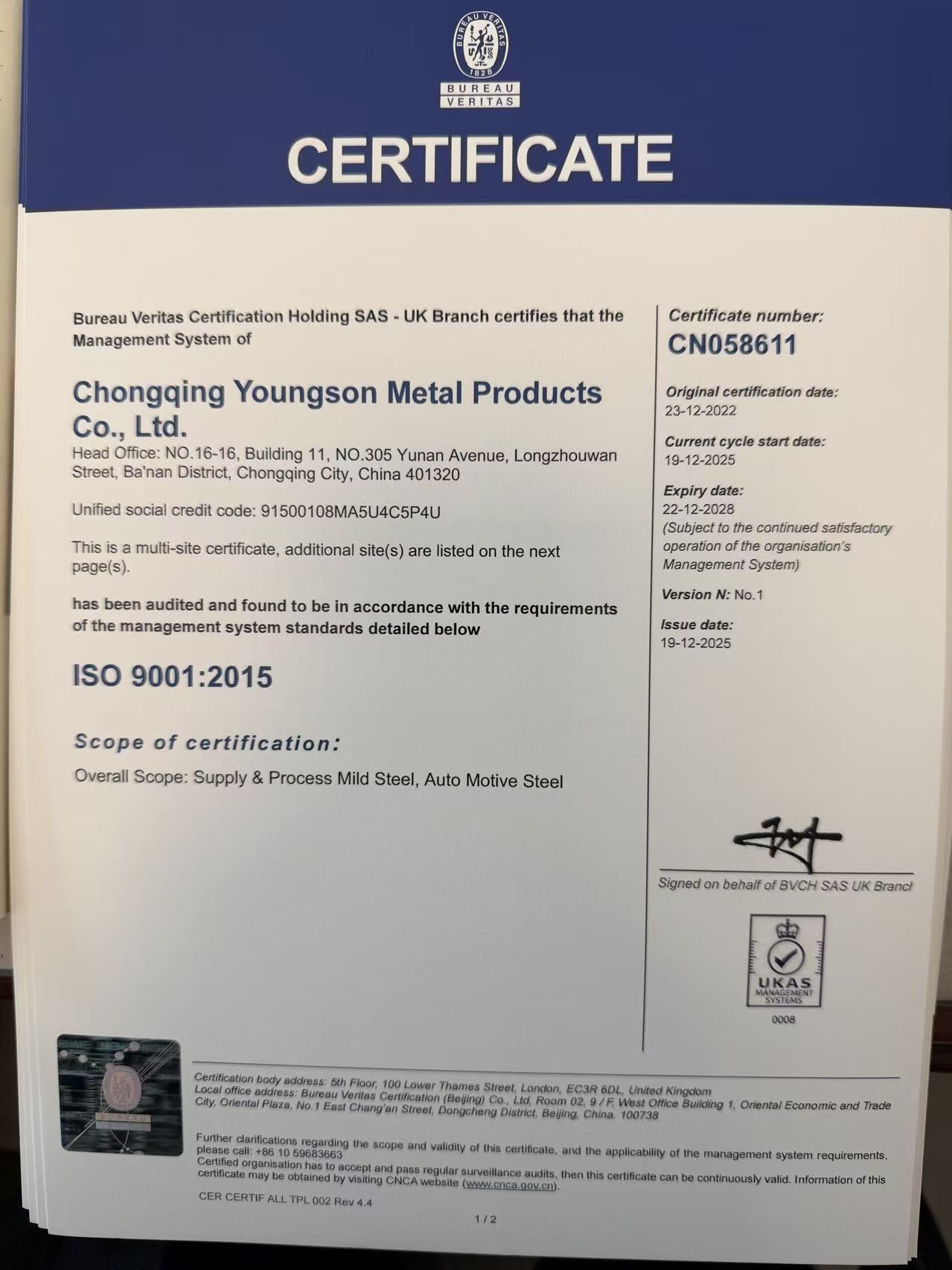
The underlying quality system is audited by Bureau Veritas under ISO 9001:2015, certificate number CN058611, issued on 23 December 2022 and valid until 22 December 2028, assessed against ASQ/ANSI/ISO 9001:2015, EN ISO 9001:2015 and JIS Q 9001:2015, with a scope covering mild steel, automotive steel and prepainted steel. Documented EPD and CFP (ISO 14067) documentation is also available.
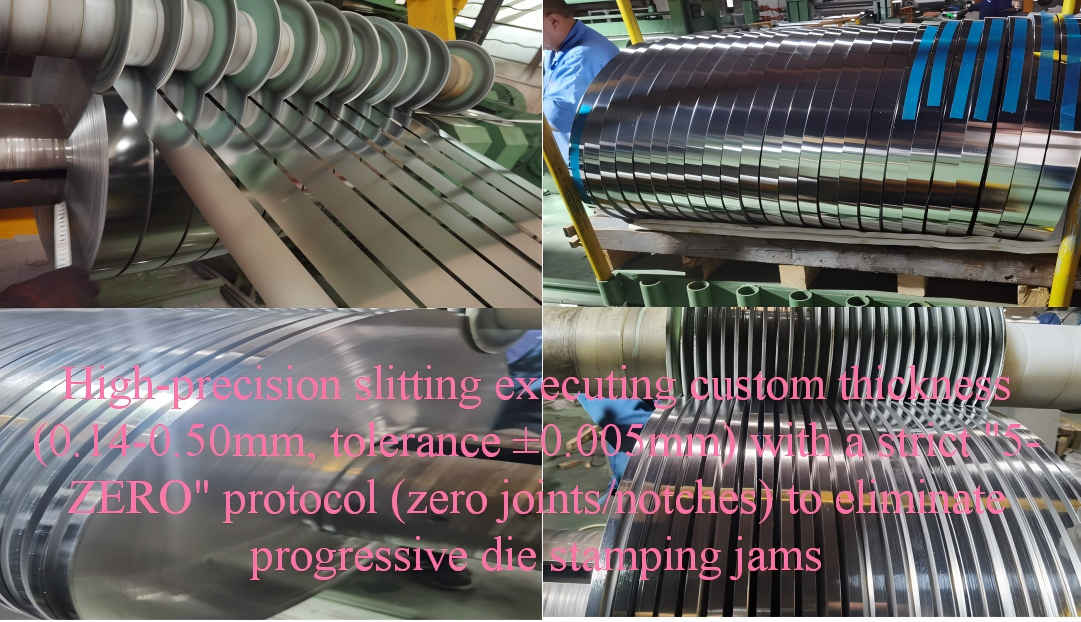
Two inspection layers are worth understanding before ordering. The first is dimensional and mechanical control: thickness tolerance held to ±0.005 mm on precision strip, width tolerance within ±0.05 mm, and slitting burr controlled to ≤0.05 mm. The second is a defect screen referred to internally as the 5-ZERO standard — zero joints, zero notches, zero wavy edges, zero overlapping bands and zero rust spots on every coil. Every slit coil is locked to a unique quality ID that links it back to the raw base metal and coating batches, so traceability survives all the way to the customer's press.
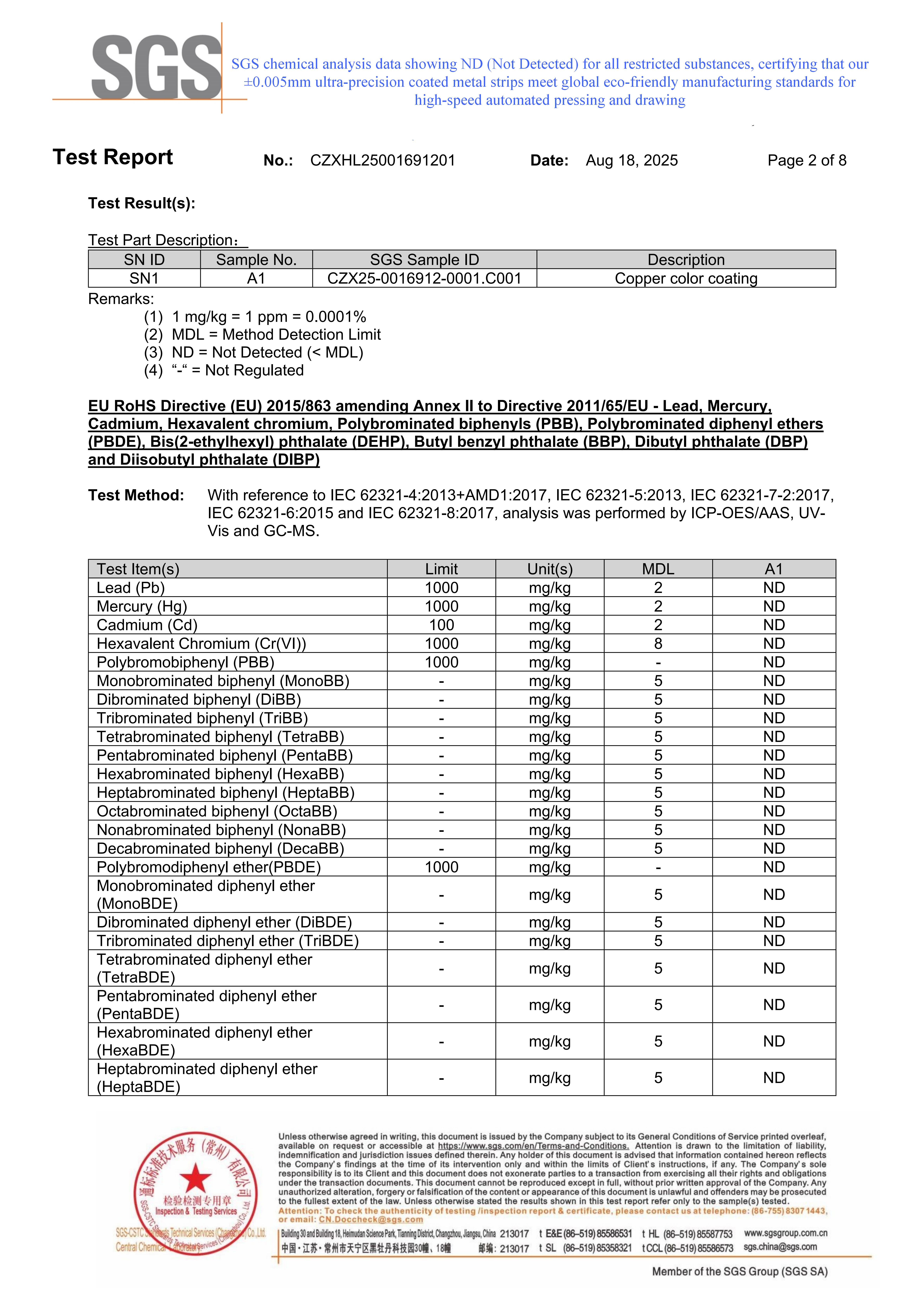
Heavy-metal compliance sits alongside the quality system. RoHS 2.0 certification is held under SGS certificate CZXHL25001691201, demonstrating compliance with directives 2011/65/EU and (EU) 2015/863 for the global market, with a certified scope covering copper colourful tinplate at 0.23 mm thickness. Coated products are additionally validated through SGS REACH and RoHS heavy-metal testing.
After-Sales Support: Metallurgy, Slitting and Carbon Data
After-sales support is structured around the two failure modes that cost a buyer the most money: material behaviour in forming, and documentation compliance. Metallurgical and slitting technical support is provided to help resolve drawing, flanging, coating adhesion and slitting-related issues on the customer's equipment. Claim handling is documented with a response within 24 hours, and remote diagnosis is supported through photo and video verification.
On the compliance side, full EU CBAM direct and indirect carbon emission data reporting is provided, backed by certified EPD and CFP (ISO 14067) documentation. This matters for European buyers who must pass embedded-emission data up their own supply chain. Third-party testing coordination and global ocean freight with tracking complete the post-delivery scope, and where a verified dimensional or material defect occurs, an accelerated compensation or cargo replacement process protects supply continuity.
What Can Be Customized on a Tinplate Order
Customization at Youngson Metal is organized as OEM/ODM support rather than a catalogue selection. Joint R&D covers customized functional coatings — high-adhesion, deep-drawing and anti-abrasion lacquers — followed by precision slitting or sheet shearing, with all goods passing SGS RoHS and food-grade testing where applicable.
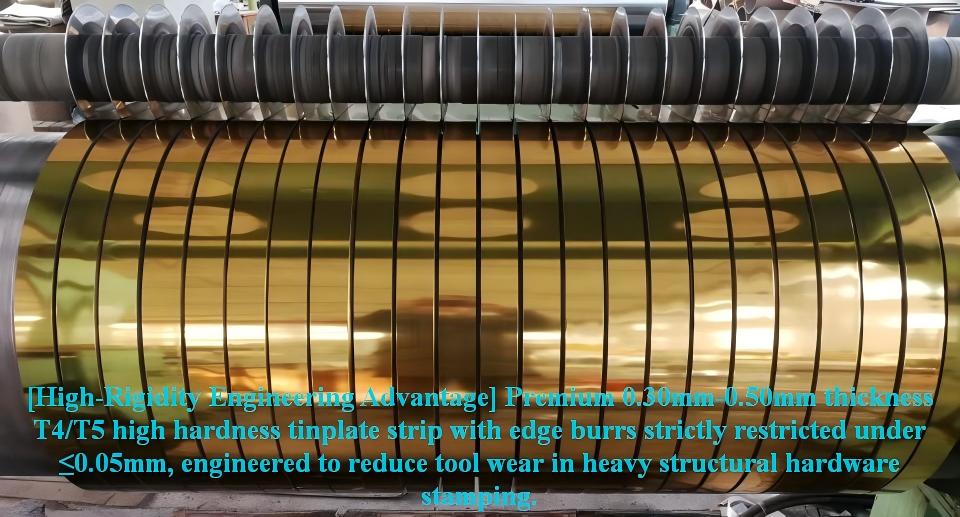
The documented customization envelope includes:
- Material grades: tinplate, pre-painted steel, cold rolled steel, galvanized steel, galvalume, Zn-Al-Mg steel, stainless steel and aluminium
- Thickness: 0.08–6.0 mm across the metal range; light-gauge tinplate and TFS strip are supplied in bands such as 0.14–0.17 mm for DR grades and 0.18–0.20 mm for T2/T3 strip
- Width and slitting tolerance: slit strip from 4.0 mm to 1050 mm, with width and slitting tolerance to ±0.02 mm on the processing line
- Zinc coating: 30–600 g/m² for galvanized and alloy-coated grades
- Tin coating mass: 1.1/1.1, 2.2/2.2 and 2.8/2.8 g/m², equal or differential
- Surface finish: 2B, BA, No.4, anti-fingerprint and RAL coatings; colour systems include lacquer, brass, golden, black, red, grey, blue and laser finishes, single-sided or double-sided
- Temper / hardness: soft, 1/4H, 1/2H and full hard, with strip tempers spanning T1 to T6 and DR8, DR9, DR10
- Coil ID / OD: inner diameters of 160 mm, 200 mm, 300 mm, 400 mm and 500 mm
- Export anti-rust packaging and CBAM / EPD carbon footprint data as part of the delivery package
Two specification details are worth flagging for buyers. First, temper is not cosmetic: a deep-drawn component and a structural bracket may require opposite ends of the hardness range from the same base metal. Second, coating adhesion is a process decision, not a paint decision — which is why the in-house coating lines and the joint development route matter more than the colour chart.
Step-by-Step: How an Order Moves From Inquiry to Repeat Order
- Specification review. The buyer submits grade, gauge, temper, coating mass or colour, slitting width, coil ID and target application. This determines whether the material is a stock-grade match or requires custom coating development.
- Quotation and MOQ confirmation. MOQ is confirmed against sizes — typically 2–3 tons, with specified programs quotable from 1 ton — together with the lead time for that exact specification.
- Sample validation. Complimentary sample rolls or sheets are available for industrial press trialling, so the material is proven on the customer's own tooling before a production run is committed.
- Production. Material is produced or processed on in-house coating and precision slitting lines, with capacity of approximately 1,200 tons per month across the operation.
- In-house inspection. 100% inspection covers thickness, coating mass, tensile strength, T-bend, salt spray and surface roughness, with the 5-ZERO defect screen applied to every coil.
- Third-party inspection (optional). SGS, BV or TÜV verification is coordinated where the buyer or end customer requires independent confirmation.
- Documentation package. MTC EN 10204 3.1 accompanies the shipment, alongside RoHS 2.0 documentation and, where required, EPD and CFP (ISO 14067) carbon data.
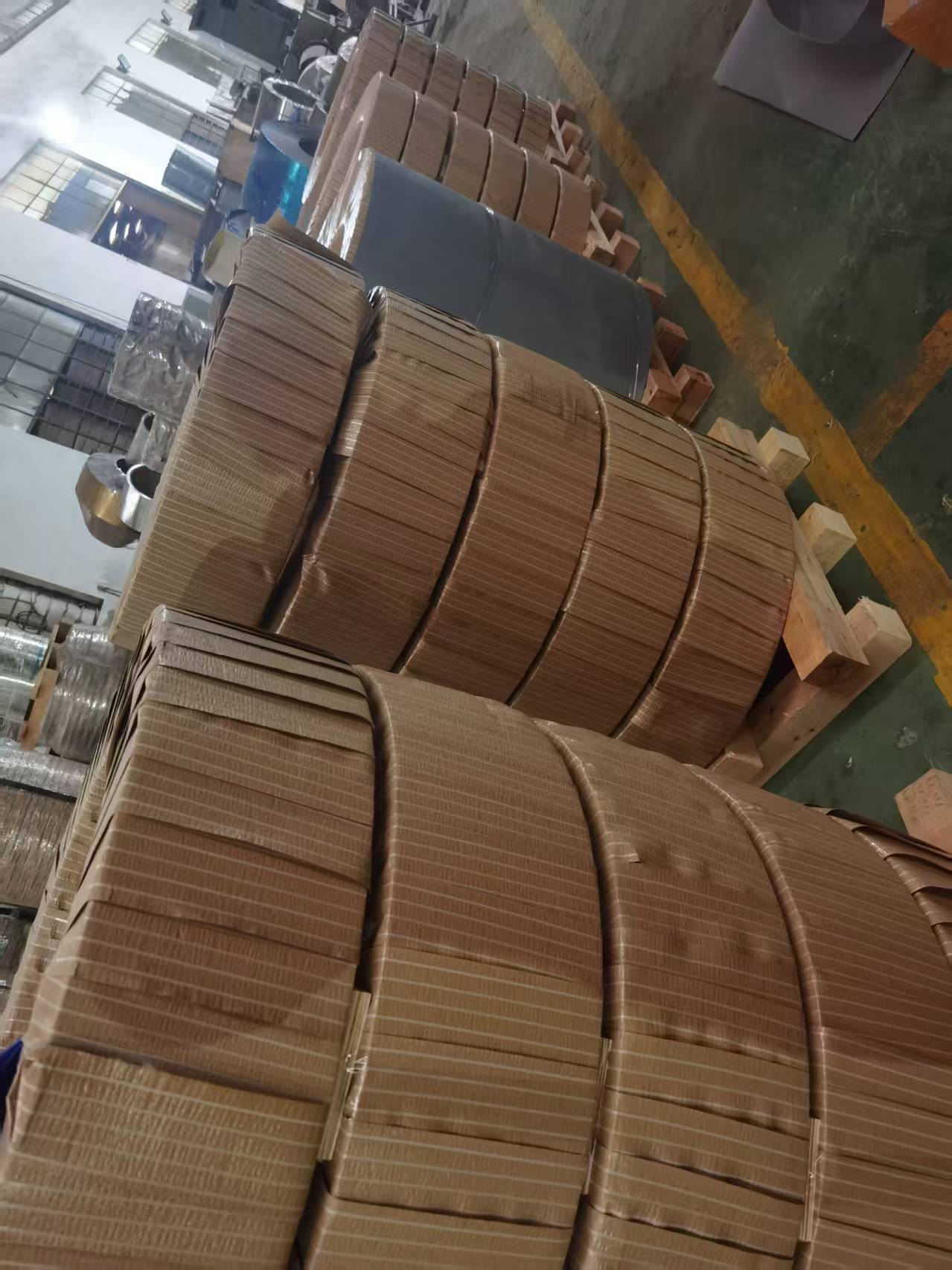
- Packing, freight and after-sales. Export anti-rust packaging protects slit edges for humid and tropical transit; global ocean freight with tracking follows, and metallurgical and slitting technical support remains available after delivery.
Use Cases: How the Answers Change by Application
The headline MOQ and lead-time figures hold across the product range, but the specification detail — and therefore the questions a buyer should ask — changes by application.
Meat can bodies. Material for 2-piece drawn and ironed meat cans is supplied as BPA-free lacquered tinplate with an internal 2-pass heavy gold coating, in thicknesses of 0.14, 0.15, 0.155 and 0.16 mm, widths of 750–1000 mm, temper grades DR8, DR9 and DR10, and a differential tin coating of 1.1/2.8 g/m². The documented performance is zero blistering and zero blushing after 121°C processing for up to 90 minutes, with resistance to fat, salt and sulfur staining. Buyers in this segment should ask for the retort test result, not just the coating weight.
Fish and seafood cans. For 2-piece DRD fish cans, the substrate is BPA-free sulfur-resistant aluminium paste coated Tin Free Steel (TFS/ECCS) in 0.14–0.16 mm, DR8–DR10, with a food-grade aluminium pigment lacquer applied at 8–12 g/m² and retort resistance at 121°C for 60 to 90 minutes. The relevant performance claim is anti-sulfur staining and zero discolouration after retort, combined with oil and brine resistance.
Deep-drawn and DR light-gauge strip. Strip in 0.14–0.17 mm with DR7, DR8, DR9 and DR10 tempers is produced with thickness tolerance of ±0.005 mm, width tolerance of ±0.05 mm and burr of ≤0.05 mm. Documented supply programs in this category include a premium candle-lid plant running 500–1,000 tons per month on 0.14–0.15 mm material for more than ten years, with die abrasion reportedly reduced through tighter thickness and burr control.
Automotive filter components. DDQ and EDDQ grades are supplied in T1 temper with a Rockwell HR30T specification of 49±3, in thicknesses of 0.20–0.50 mm and 2.8/2.8 g/m² tin coating. A separate filter-core grade covers 0.21, 0.24, 0.25 and 0.30 mm with the same tolerance discipline, supported by more than eight years of R&D and manufacturing experience in the filter component supply chain.
Precision narrow strip for hardware and stationery. Ultra-narrow material at 0.20 mm in 6.5 mm and 7.0 mm widths is produced to ±0.03 mm width tolerance with 4.2/4.2 to 5.6/5.6 g/m² tin coating and identical coil weight and outer diameter per batch for synchronized feeding. Narrow-strip buyers should confirm width tolerance and coil consistency first — they determine whether an automated line runs without stoppages.
Supply Scope Comparison: Parameters Buyers Compare Side by Side
| Supply scope | Minimum order quantity | Typical production lead time | Key dimensional control | Documentation supplied |
|---|---|---|---|---|
| Commercial-grade tinplate & TFS coil and sheet | 2–3 tons as per sizes | 5–30 days as per sizes | Gauge and coating mass to specification | MTC EN 10204 3.1; EPD & CFP (ISO 14067) on request |
| Precision slit strip, 4.0–1050 mm | 2–3 tons as per sizes; specified programs from 1 ton | 14–25 days or as per specifications | Width ±0.05 mm; thickness ±0.005 mm; burr ≤0.05 mm | BV ISO 9001:2015 system; batch-traceable MTC |
| Coated & pre-painted tinplate strip | 2–3 tons as per sizes | 14–25 days or as per specifications | Coating adhesion, colour and film weight verified in-house | SGS RoHS 2.0 (CZXHL25001691201); MTC EN 10204 3.1 |
| Deep-drawn grade tinplate / TFS (DDQ, EDDQ, DR) | 2–3 tons as per sizes | 5–30 days as per sizes | Thickness ±0.005 mm; burr ≤0.05 mm; 5-ZERO defect screen | MTC; third-party inspection supported (SGS / BV / TÜV) |
The pattern in the table is consistent: as the specification becomes more demanding, the inspection depth and documentation depth increase with it. That is the practical trade-off a buyer should evaluate, rather than comparing a single lead-time number across different scopes.
FAQ: Tinplate Partnership Questions Answered
Is Youngson Metal a RoHS-certified tinplate manufacturer?
Yes. YOUNGSON METAL holds RoHS 2.0 certification issued by SGS under certificate number CZXHL25001691201, demonstrating compliance with directives 2011/65/EU and (EU) 2015/863 for the global market, with a certified scope covering copper colourful tinplate at 0.23 mm thickness. Coated products are additionally validated through SGS REACH and RoHS heavy-metal testing. Heavy-metal compliance is therefore documented at certificate level rather than stated as a general claim.
What can be customized on a tinplate order?
Customization covers material grade, thickness from 0.08 mm to 6.0 mm across the metal range, slit width from 4.0 mm to 1050 mm with width and slitting tolerance to ±0.02 mm, zinc coating from 30 g/m² to 600 g/m² on galvanized grades, tin coating mass of 1.1/1.1, 2.2/2.2 or 2.8/2.8 g/m², surface finish including 2B, BA, No.4, anti-fingerprint and RAL coatings, temper and hardness from soft through full hard, and coil inner diameters of 160, 200, 300, 400 or 500 mm. Joint R&D is available for customized functional coatings such as high-adhesion, deep-drawing and anti-abrasion lacquers.
What is the minimum order quantity for tinplate?
Standard minimum order quantity is 2–3 tons as per sizes. Where a program is specified through the precision slitting and pre-coated strip plant, orders can be quoted from 1 ton or as per specifications. Because MOQ depends on the size and coating configuration that must be set up, it is quoted together with the specification rather than as a fixed company-wide number.
Can buyers validate material with a sample before a full order?
Yes. Complimentary sample rolls or sheets are available for industrial press trialling, allowing the material to be tested on the buyer's own tooling before a production order is committed. This is particularly relevant for deep-drawn, DDQ and EDDQ applications, where coating adhesion and formability have to be proven under real draw ratios rather than on a specification sheet.
How long does tinplate production and delivery take?
Typical production lead time is 5–30 days as per sizes, with precision slitting and coated-strip programs commonly quoted at 14 to 25 days or as per specifications. Inspection runs in parallel: 100% in-house checks on thickness, coating mass, tensile strength, T-bend, salt spray and surface roughness, an MTC EN 10204 3.1 with each shipment, and optional third-party verification through SGS, BV or TÜV. Once material is delivered, metallurgical and slitting technical support, 24-hour claim response and full EU CBAM carbon emission data reporting continue through the partnership — buyers can request a quotation or a sample against their own specification to confirm MOQ and lead time for their exact sizes.
Conclusion: What a Documented Tinplate Partnership Looks Like
The five questions in this article have specific, checkable answers. MOQ is 2–3 tons as per sizes, with specified programs quotable from 1 ton. Lead time is 5–30 days as per sizes, and 14–25 days for precision slitting and coated strip. Inspection is 100% in-house with an MTC EN 10204 3.1, supported by optional SGS, BV or TÜV verification, a BV ISO 9001:2015 quality system and RoHS 2.0 certification. Customization spans material grades, 0.08–6.0 mm thickness, ±0.02 mm slitting tolerance, 30–600 g/m² zinc coating, surface finish and temper. After-sales support covers metallurgical and slitting assistance, 24-hour claim response and EU CBAM carbon emission data reporting under certified EPD and CFP (ISO 14067) documentation.
For a buyer at the evaluation stage, the useful next step is not a general enquiry but a specification-level one: send the grade, gauge, temper, coating, slit width and coil ID you need, and ask for the MOQ, lead time and documentation package that applies to those exact sizes. Sample rolls or sheets can be arranged for press trialling before any production commitment.
YOUNGSON METAL — Chongqing Youngson Metal Products Co., Ltd.
Website: www.youngsonmetal.com
Email: info@youngsonmetal.com
Tel: 0086-23-62566629 | WhatsApp: 0086-13594107385
Address: NO.16-16, Building 11, NO.305 Yunan Avenue, Longzhouwan Street, Ba'nan District, Chongqing, China 401320
Full product range, specifications and certification details: Download the Chongqing Youngson Metal Products catalogue (PDF).
Have Questions or Need More Details?
Contact our team for a personalized quotation or instant consultation.
Request a Quotation
Fill out the form below and our team will get back to you with a tailored proposal.
WhatsApp Direct Chat
Prefer to chat in real-time? Message us on WhatsApp for instant assistance & quick answers.
- Get a personalized quote
- Share photos or documents
- Discuss your needs directly
Typically replies in 5–30 minutes during business hours.