Mirror Gold Tinplate vs Copper-Plated Steel vs Stainless Steel: A Cost-Saving Comparison Guide
Mirror Gold Tinplate vs Copper-Plated Steel vs Stainless Steel: A Cost-Saving Comparison Guide
Choosing between mirror gold tinplate, copper-plated steel strip and stainless steel is a cost decision disguised as a finish decision. All three can deliver a warm, reflective, corrosion-resistant surface on hardware and packaging, but they reach that result through different substrates, different process routes and different documentation burdens — and those differences move landed cost far more than the finish name written on the drawing.
The short answer for evaluation-stage buyers: where the requirement is decorative reflectivity, fingerprint resistance and normal indoor corrosion duty, an anti-fingerprint mirror gold tinplate strip in the 0.20 mm – 0.50 mm range is positioned as the cost-saving substitute for SUS201/SUS410 stainless and for copper-plated strip, because it uses a light-gauge electrolytic tinplate (ETP) substrate plus a coil-coated organic layer instead of a heavy alloy substrate or an electroplating step. Where duty is genuinely severe — continuous salt exposure, structural load, high-temperature service, or a customer drawing locked to a stainless grade — stainless remains the correct selection and coated strip should not be forced into that role.
This guide compares the three routes across the factors that actually decide the order: reflectivity and appearance consistency, anti-fingerprint behaviour, formability in deep drawing and stamping, landed cost drivers, and the compliance documentation package a modern buyer is expected to hand over.
Chongqing Youngson Metal Products Co., Ltd. (YOUNGSON METAL), founded in 2016 and based in Chongqing, China, is a BV ISO 9001:2015 certified manufacturer of precision slit tinplate and TFS strip, pre-coated and pre-painted steel, supplying metal packaging, hardware, appliance and automotive customers in global markets.
Answer in one line: mirror gold tinplate wins on cost where the part needs appearance, fingerprint resistance and moderate corrosion duty; copper-look coated strip wins where the design calls for a copper tone or mild thermal exposure; stainless steel stays the correct choice where load, temperature or continuous salt exposure is the real constraint.
Problem Definition: Why Decorative Surfaces Get Over-Specified
Over-specification on decorative parts usually follows one of three patterns.
Spec-by-habit. A part was originally designed around polished stainless, and every later revision copies the previous drawing. Nobody re-tests whether the component actually sees salt spray, abrasion or mechanical load — the stainless grade simply stays on the drawing for years.
Invisible handling cost. A high-gloss surface that shows every fingerprint forces gloves, wiping stations and rework on the assembly line. That cost never appears in the material quotation, so it is never compared against a finish that resists fingerprints by design.
Documentation drift. Buyers supplying regulated markets must produce material traceability, third-party inspection records and, increasingly, carbon data. A surface route that cannot issue a mill test certificate to EN 10204 3.1, or that cannot map emissions to EU CBAM reporting, turns an apparently cheap quote into an expensive compliance project.
All three patterns point the same way: compare surfaces on function and total cost, not on material prestige.
Industry Background: Where Mirror, Copper-Look and Stainless Substitutes Sit
The decorative end of coated steel demand does not move in isolation. Fortune Business Insights valued the global tinplate market at USD 14.59 billion in 2023 and projects it to reach USD 19.38 billion by 2032, with growth concentrated in packaging and consumer hardware where surface appearance matters as much as barrier performance. In China, the largest tinplate export origin, exports under HS code 721012 reached 1.4 million tons in the first three quarters of 2023 according to the General Administration of Customs of China, driven primarily by canned food packaging — a signal of how much coated strip now moves in international trade.
Two technical trends sit behind the migration toward coated alternatives:
- Light-weighting with Double Reduced (DR) strip. DR tinplate as thin as 0.14 mm – 0.16 mm, for example DR8, is increasingly specified for cost reduction and light-weighting in metal packaging, which makes decorative pre-coated strip viable in gauges that copper-plated or stainless substrates rarely reach.
- Standardised temper and mechanical grading. Tinplate specifications (SPTE/ECCS) are normally written against ASTM A623 or EN 10202, covering temper grades from T1 to T5 and DR7 to DR9. A buyer comparing coated strip against a stainless substrate is really comparing a graded, documented carbon-steel construction against a different alloy system — the two need separate acceptance logic.
The Three Options in One View
The table below compares the decorative coated routes against a stainless substrate on the factors that drive a purchase decision. Cells marked as mill-governed are deliberately left open: stainless properties come from the mill's own grade and finish declaration, not from the coating supplier, and should be validated against the mill certificate before any comparison is finalised.
| Decision factor | Anti-fingerprint mirror gold tinplate (MFG-200 series) | Copper-look coated strip (ECO-BRONZE-TP) / copper-plated strip | Stainless steel substrate (SUS201 / SUS410 / SUS430) |
|---|---|---|---|
| Surface character | Specular mirror finish with anti-fingerprint topcoat; luxury brass, royal gold, matte black, bright black | Mirror or coated bronze / copper / brass tone; decorative copper appearance without a plated layer | Mill-declared finish; typically a metallic rather than a coated appearance |
| Thickness range | 0.20 mm – 0.50 mm | 0.15 / 0.20 / 0.21 / 0.22 / 0.30 mm | Governed by the stainless mill's standard gauges; confirm per order |
| Width and slitting | 4.0 mm – 1050 mm; custom slitting tolerance held to ±0.02 mm on specified programmes | 4.0 mm – 1050 mm; custom slitting available | Slitting performed by the processor; tolerance declared per programme |
| Temper / hardness | T2, T2.5, T52, T55, T57 — specified for drawing and stamping | HV 120–180, optimised for deep drawing and high-speed stamping | Determined by the selected stainless grade and temper |
| Tin coating mass | 2.8 / 2.8 g/m² | 2.8 / 2.8 or 2.2 / 2.2 g/m², equal or differential | Not applicable to a stainless substrate |
| Anti-fingerprint behaviour | Oleophobic anti-fingerprint nano-treatment, single side or double side | Available on eco-friendly coating options; confirm with the finish selected | Depends on the mill finish; polished surfaces generally show handling marks |
| Formability | Designed for deep drawing and flexible stamping | Withstands 120 °C continuous heat for 5 hours with zero peeling or blistering | Grade-dependent; validate against the forming severity of the part |
| Substance compliance | RoHS & REACH certified, heavy-metal-free coating | REACH & RoHS tested; SGS RoHS certificate issued for copper colourful tinplate at 0.23 mm | Declaration issued by the mill |
| Documentation package | MTC EN 10204 3.1, SGS/BV/TÜV third-party inspection, ISO 14067 EPD & CFP with EU CBAM carbon data | Same supplier documentation route as the coated tinplate family | Mill test certificate plus mill-issued environmental data |
| Typical fit | Decorative packaging, electronics enclosures, architectural trim, furniture hardware | Copper-tone tins, candle lids, retro packaging, mild thermal parts | Structural, high-humidity or high-temperature duty where the substrate carries the load |
Reflectivity and Appearance: What Each Surface Actually Looks Like
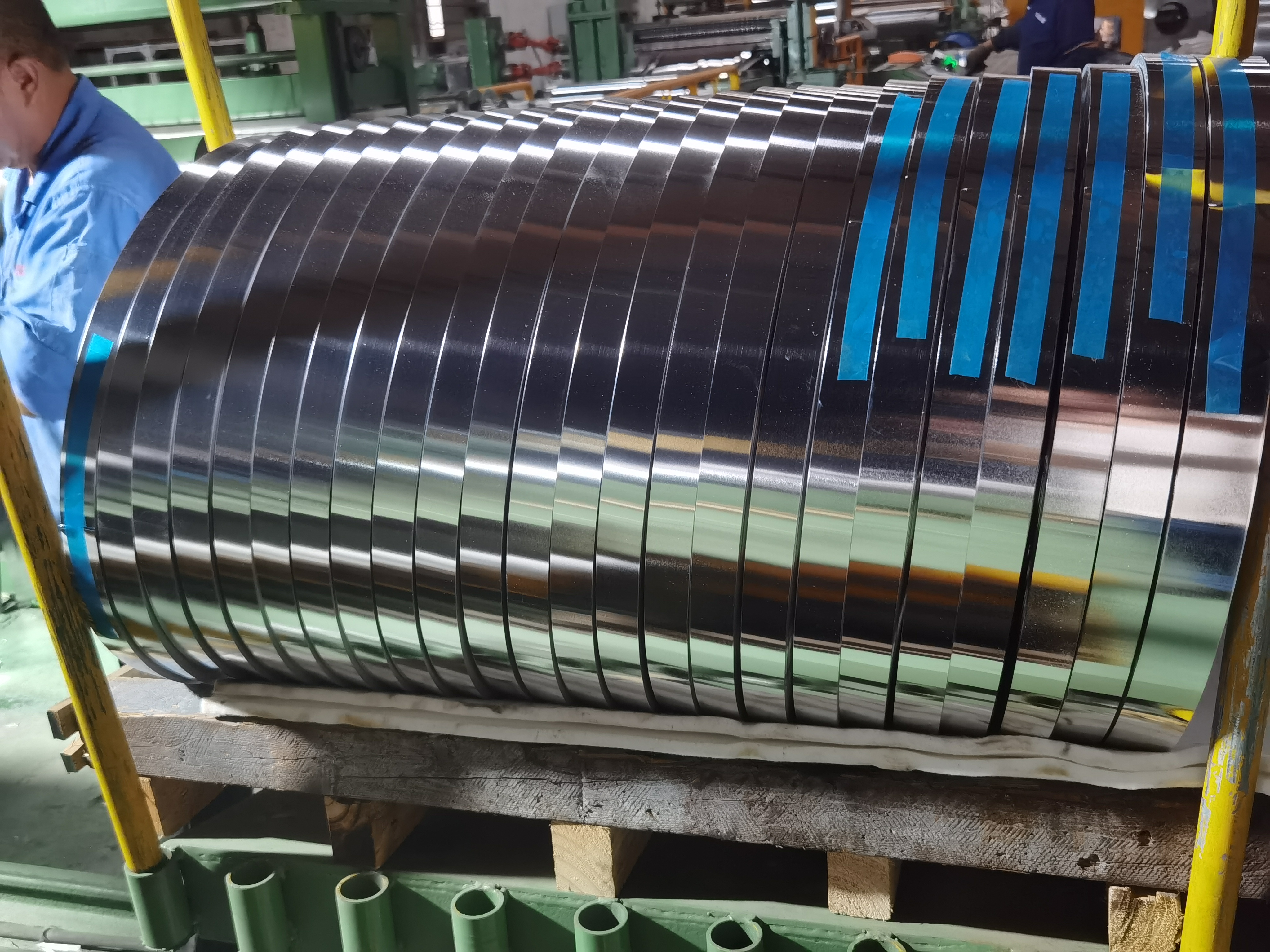
Reflectivity is a process outcome, not a colour. A mirror finish is produced by controlling surface topography and then applying a high-adhesion coloured coating, giving a specular surface that reflects images with low diffusion. YOUNGSON METAL's mirror finish slit steel strip family covers 0.18 mm – 0.55 mm in T2.5, T3, T4, T5, DR8 and DR9 hardness and widths from 4 mm to 1000 mm, and is specified for luxury packaging, decorative enclosures, architectural trim and stationery components.
Warm tones — gold, brass, copper and bronze — are available on both the mirror and the matte routes. The anti-fingerprint mirror gold tinplate series is offered in luxury brass, royal gold, matte black and bright black with a single-side or double-side eco-friendly coating. The mirror bronze substitute extends the same construction into antique bronze, rich copper and polished brass. A copper-look coated strip delivers the decorative copper tone at 0.15 mm, 0.20 mm, 0.21 mm, 0.22 mm and 0.30 mm.
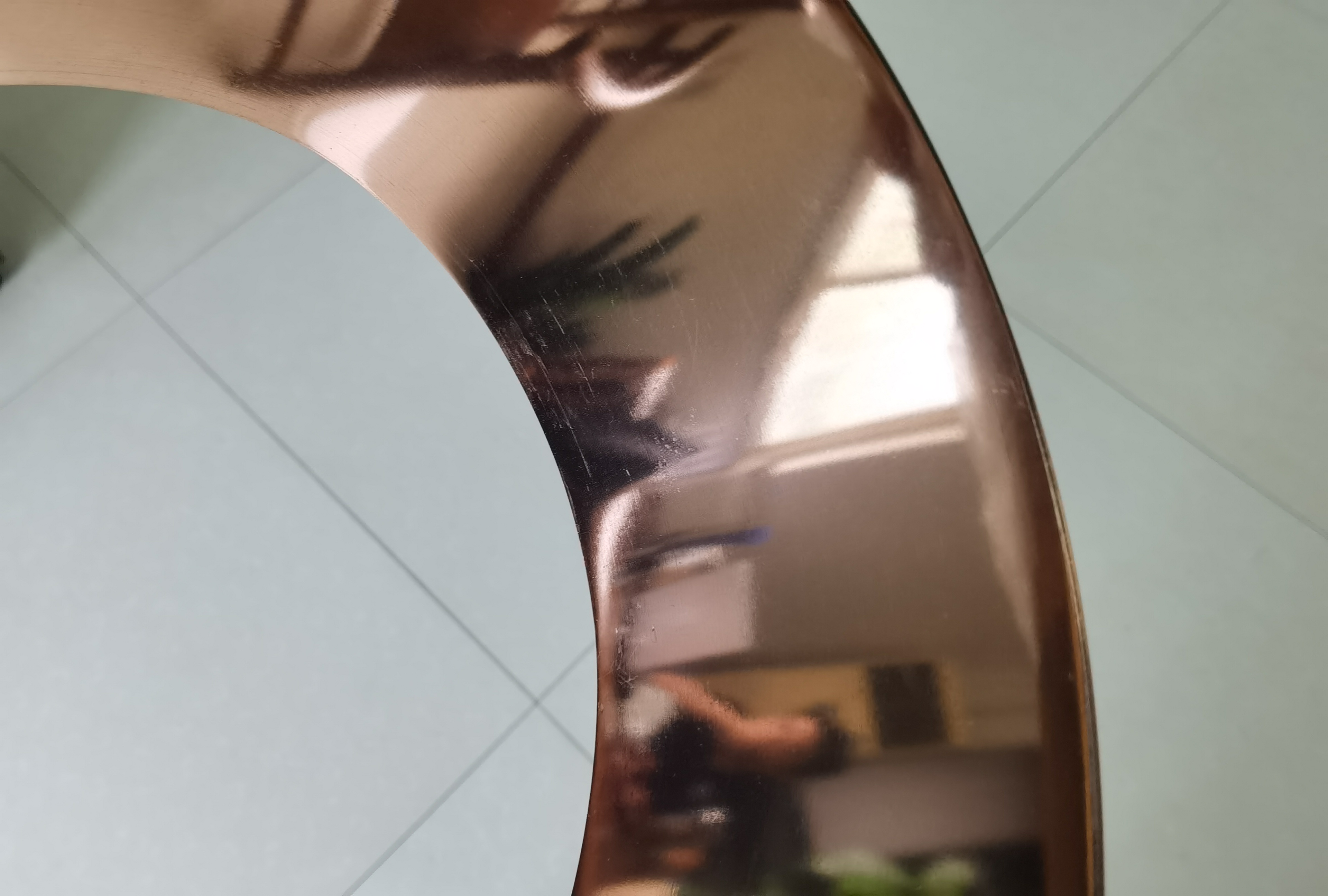
Where copper plating has historically been specified for a specific metallic tone, the pre-coated copper-look route reproduces the appearance without the plated layer — which is how the product is positioned in the supplier's own catalogue, as a cost-saving alternative to copper-plated steel strip. The buyer's real check is therefore not "does it look like copper", but two harder questions: does the finish survive forming without cracking, and is the appearance consistent from coil to coil and batch to batch?
Anti-Fingerprint Behaviour: The Handling Cost Most Buyers Miss
Fingerprint marks are a genuine cost item on visible parts. On a high-gloss mirror surface, skin oils leave visible prints that require gloved handling, wiping stations or rework; on textured matte surfaces the same marks are far less visible.
Two finishes solve the problem from opposite directions:
- Oleophobic anti-fingerprint (AF) nano-treatment over a mirror finish keeps the reflective look while resisting fingerprint adhesion. It can be applied to one side or both sides.
- Anodized-look matte tinplate uses a non-reflective, anti-glare coarse matte texture with a sleek feel, hardness in the HV 120–180 band, and colour options including luxury bronze, brass, metallic golden, matte black and bright black.
Both routes exist because buyers previously had to choose between "reflective but fingerprint-prone" and "fingerprint-tolerant but visually flat". A mirror finish carried by an AF topcoat removes that trade-off on parts where the reflective look is the entire design intent.
Formability in Deep Drawing and Stamping
Formability decides whether a decorative surface survives the press. Deep drawing and severe stamping stretch the coated surface and can crack or delaminate the lacquer layer; when that happens the part is scrap and the apparent material saving disappears with it.
The relevant capability envelope looks like this:
- Tempers T2, T2.5, T52, T55 and T57 are specified for the mirror gold and mirror bronze decorative series, covering drawing and stamping duty.
- The copper-look coated strip is offered at HV 120–180 — a hardness band selected for deep drawing and high-speed precision stamping — and withstands 120 °C continuous heat for five hours with zero paint peeling and zero blistering.
- The matte anodized-look series is specified for high-elongation deep drawing with zero paint peeling during stamping and crimping.
- Gold pre-painted deep-drawing strip at 0.14 mm – 0.15 mm runs from T1 through DR7, DR7.5, DR8, DR9, DR10 and TH520, with slitting burr held at ≤0.05 mm to protect progressive dies.
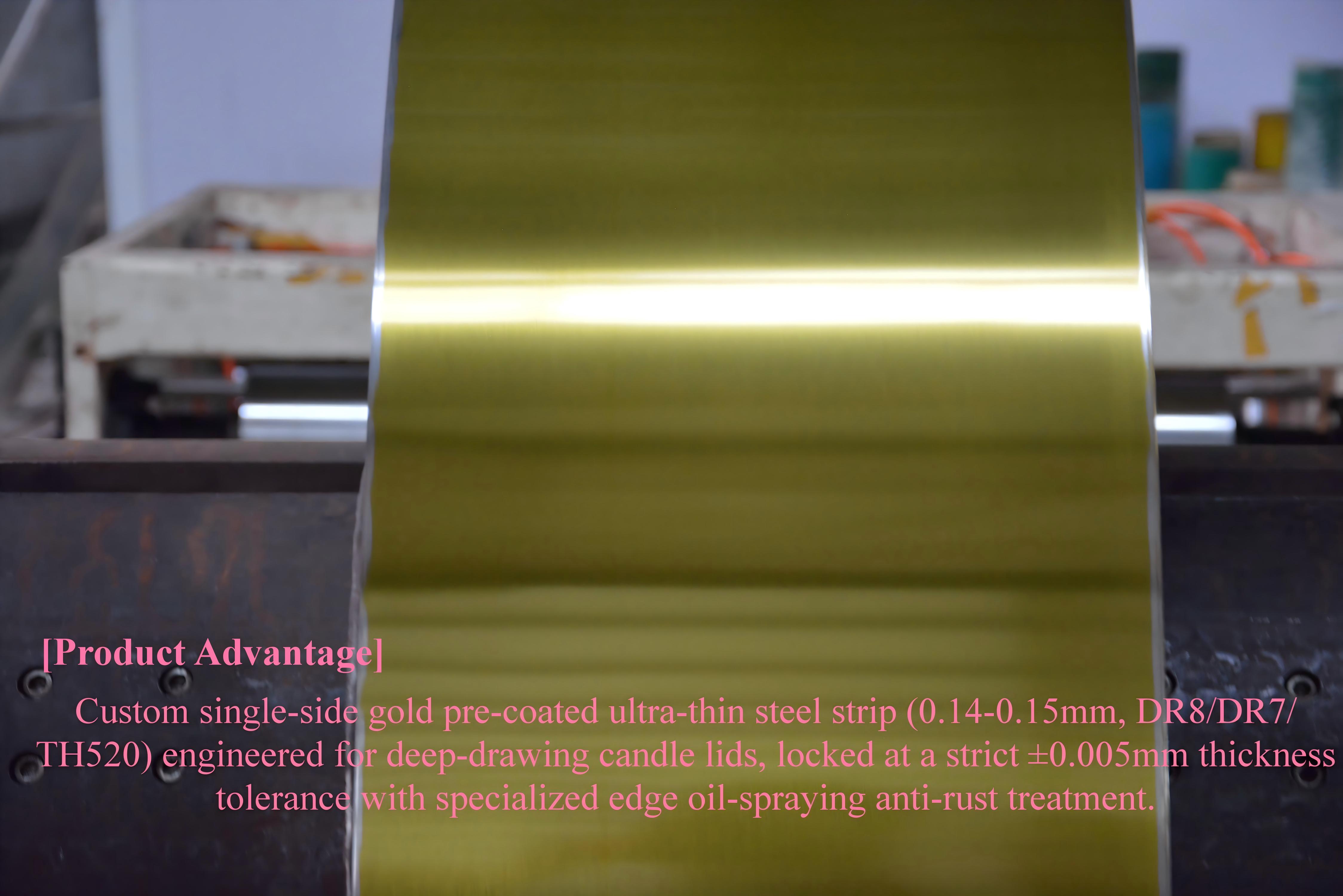
Field evidence supports the same conclusion. A programme supplying a 0.14 mm – 0.15 mm ultra-thin high-tensile matrix (DR8/DR7/TH520) for automated progressive-die deep drawing of premium single-side gold candle lids has run for more than 10 years at 500–1,000 tons per month to global markets, achieving zero coating peeling, zero tooling crashes, a 35% reduction in die abrasion attributed to thickness tolerance and burr control, and zero oxidation during humid shipping. A second programme delivering 6,000+ tons annually of precision slit strip and multi-colour coated coil for high-speed progressive die stamping of electronics shielding enclosures and non-round fish cans reports 0% coating delamination or foil bursting during deep drawing and a 35% gain in progressive die tool life.
Dimensional control is what makes that repeatable: thickness tolerance within ±0.005 mm and slitting burr ≤0.05 mm, with coils supplied joint-free, free of wavy edges and free of overlapping bands so that automated feeding is not interrupted.
Landed Cost: Five Drivers Buyers Should Compare
Comparing a coated tinplate strip against a copper-plated strip or a stainless substrate on unit price alone produces the wrong ranking, because the cost sits in five different places.
- Substrate cost. The base metal mass and alloy grade dominate unit cost. Stainless grades and copper-bearing substrates carry their own alloy premium, while electrolytic tinplate (ETP) is a light-gauge carbon steel with a thin tin coating.
- Process route. Copper plating is generally an electrochemical deposition step that adds bath control and effluent management to the production flow. A coil-coated decorative layer is applied in-line on the coating line and the coil is then slit to width, which keeps the decorative function in the same material flow as the delivery format.
- Forming yield and tool wear. A surface that cracks or delaminates during deep drawing converts into scrap. Coating adhesion, thickness tolerance and burr control therefore translate directly into yield, and in the field cases above the combination of ±0.005 mm thickness tolerance and ≤0.05 mm burr was linked to a 35% reduction in die abrasion.
- Handling and finishing labour. Anti-fingerprint treatment removes a proportion of the gloving, wiping and rework that a bare high-gloss or polished surface generates on a visible part.
- Logistics and compliance documentation. Coil weight, edge protection and packaging affect freight and damage claims, while carbon documentation and third-party inspection records create a fixed administrative cost per shipment regardless of surface type.
Add those five drivers before comparing quotations. The cost-saving logic of the mirror gold and copper-look coated routes is not a discount claim; it is that the substrate stays a light-gauge electrolytic tinplate and the decorative function is delivered by a coating rather than by alloy mass or a plated layer — which is exactly how these products are positioned, as SUS201/SUS410 and copper-plating substitutes where the corrosion and load duty of the original specification was never actually required.
Compliance and Documentation: What Should Travel With the Order
Decorative surfaces now move with a paperwork package, and buyers should specify it before the first shipment rather than after an audit request:
- Quality system: BV ISO 9001:2015 certification (certificate CN058611, issued 2022-12-23, valid to 2028-12-22) covering mild steel, automotive steel and pre-painted steel.
- Material traceability: mill test certificates to EN 10204 3.1 for each batch.
- Third-party inspection: SGS, BV or TÜV inspection supported on request.
- Substance compliance: SGS-tested RoHS compliance — for example certificate CZXHL25001691201 issued for copper colourful tinplate at 0.23 mm, tested against 2011/65/EU and (EU) 2015/863 using the IEC 62321 series — together with REACH compliance. The mirror gold, mirror bronze and copper-look coatings are described as heavy-metal-free and REACH/RoHS certified.
- Food-contact suitability where relevant: coated steel intended for food contact is generally assessed against FDA 21 CFR 175.300 requirements for coatings and lacquers.
- Carbon documentation: ISO 14067 EPD and CFP documentation, with direct and indirect EU CBAM carbon emission data reporting, plus a documented response window for material quality claims.
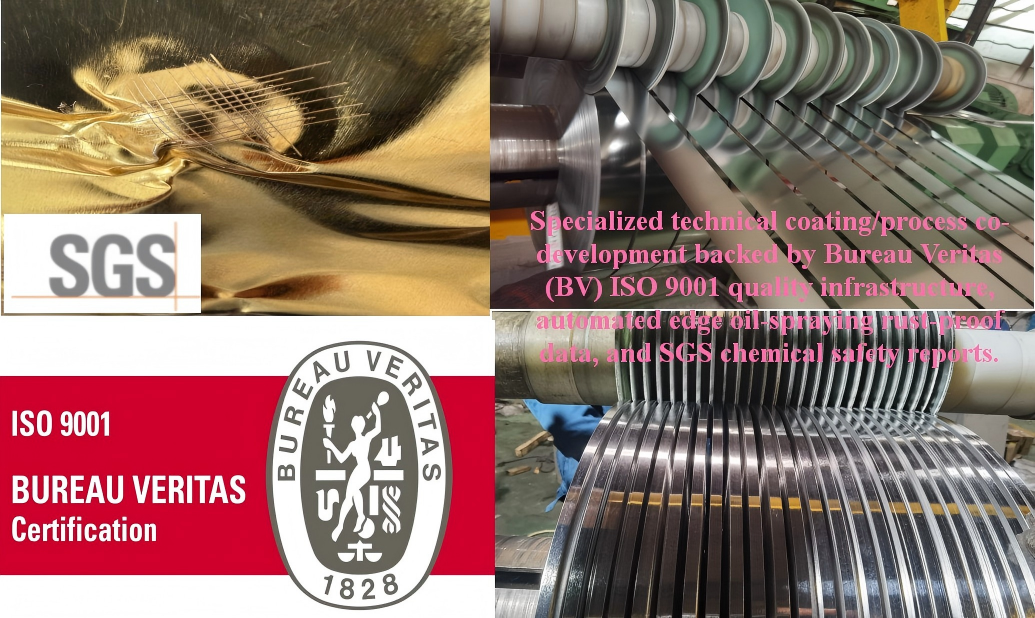
The carbon item is where coated and plated routes diverge commercially. A buyer who must report embedded carbon for CBAM purposes needs an emissions figure attached to the shipment, not a marketing statement — and the supplier has to be able to issue it as part of the normal order cycle.
Step-by-Step Selection Breakdown
Work through these six steps before releasing a quotation request. They are ordered so that the material decision is made after the duty is defined, not before.
Step 1 — Define the duty, not the material
Write down the exposure (dry indoor, humid indoor, occasional salt, continuous salt, chemical), the service temperature, and whether the finished part is handled bare-handed. If the answer is indoor, moderate and handled, a decorative coated strip belongs in scope. If it is continuous salt exposure or a load-bearing structural part, stainless stays.
Step 2 — Fix the aesthetic reference physically
Decide mirror, matte or textured, and fix the colour against a physical sample rather than a screen image. Mirror gold, mirror bronze and matte anodized-look surfaces read very differently under retail lighting, and the matte route should be selected deliberately where glare or fingerprint visibility is a problem.
Step 3 — Confirm the gauge and width envelope
Check that the required thickness sits inside the available range and that slit width is achievable without joints. Typical coated decorative ranges run from 0.15 mm upwards, with widths from 4.0 mm to 1050 mm and slitting tolerance held to ±0.02 mm on specified programmes.
Step 4 — Validate forming before aesthetics
Match temper to the forming severity: T1–T5 and DR7–DR10 for drawn parts, HV 120–180 for the copper-look stamping route. If the part is deep drawn, confirm the coating is specified as anti-peeling for that deformation level, and confirm burr level ≤0.05 mm if the strip feeds a progressive die.
Step 5 — Decide the coating sides and the AF side
Single-side or double-side coating, and anti-fingerprint treatment on one face or both, should be specified against how the part is assembled. Applying AF treatment to a hidden face adds cost without adding value.
Step 6 — Lock the documentation and run a press trial
Confirm MTC EN 10204 3.1, third-party inspection availability and carbon documentation before the order, then validate the material on your own press with a sample coil rather than a flat sheet. Check joint-free construction, edge wave, camber, winding tightness and consistent coil weight and inner diameter, because those are the variables that stop a high-speed line.
Use Cases: Where Each Surface Wins
| Application | Recommended decorative route | Why |
|---|---|---|
| Luxury gift boxes, tea caddies, confectionery and cosmetic tins | Anti-fingerprint mirror gold tinplate | High reflectivity plus handling resistance on a visible retail surface |
| Scented candle tins and lids, retro handicrafts, spirit gift packaging | Copper-look coated strip (0.15–0.30 mm) | Warm copper tone with thermal stability at 120 °C for 5 hours and zero peeling |
| Electronics enclosures, smart appliance fascias, shielding cans | Mirror gold tinplate with AF topcoat, or matte anodized-look | Decorative surface with stamping and drawing performance |
| Elevator cabin interiors, architectural trim, decorative wall panels | Mirror bronze or mirror gold coated strip | Consistent metallic appearance with anti-fingerprint handling behaviour |
| Furniture hardware, lighting fixtures and reflector components | Mirror finish strip; matte where glare is unacceptable | Reflectivity is a design feature, and matte removes glare and print visibility |
| Stationery hardware, luxury binders, file mechanisms | Precision narrow slit strip | Width tolerances and joint-free coils matter more than colour |
| Automotive decorative accents and gasket components with mild heat | Copper-look coated strip | Thermal stability and stamping performance under continuous heat |
| Continuous salt exposure, structural or load-bearing parts | Stainless steel substrate | The constraint is the substrate duty, not the finish |
Selection Checklist: Mirror Gold vs Anodized-Look Matte vs Plated vs Stainless
Use this checklist as a final gate before freezing the specification.
- Choose anti-fingerprint mirror gold tinplate when: the part needs a specular gold, brass or copper-toned finish; it is handled bare-handed or displayed; corrosion duty is dry or humid indoor; thickness sits between 0.20 mm and 0.50 mm; and the buyer wants documented MTC, third-party inspection and carbon data on the order.
- Choose anodized-look matte tinplate when: glare or print visibility is unacceptable; a brushed or anodized-aluminium appearance is the design reference; hardness in the HV 120–180 band suits the stamping operation; and high-elongation deep drawing without coating peel is required.
- Choose copper-look coated strip when: the colour target is bronze or copper; thickness is in the 0.15–0.30 mm range; the part sees continuous heat up to about 120 °C; and the original specification called for copper plating that was never strictly needed for conductivity.
- Stay with stainless steel when: the duty includes continuous salt or aggressive chemical exposure; the component is structural or load-bearing; service temperature exceeds what an organic coating system is specified for; or the end customer's drawing is locked to SUS201, SUS410 or SUS430 and cannot be revised.
FAQ
Are mirror gold and copper-look coated tinplate strips RoHS and REACH compliant for global markets?
Yes, where the supplier documents it. YOUNGSON METAL holds a BV ISO 9001:2015 quality management certificate (CN058611, valid to 2028-12-22) and produces SGS-tested RoHS records — for example certificate CZXHL25001691201 issued for copper colourful tinplate at 0.23 mm, tested against 2011/65/EU and (EU) 2015/863 using the IEC 62321 series methods. The mirror gold, mirror bronze and copper-look coatings are described as heavy-metal-free and REACH/RoHS certified, and food-contact coated steel is generally assessed against FDA 21 CFR 175.300 for coatings and lacquers.
What thickness, width and temper ranges are available for mirror gold, mirror bronze and matte decorative tinplate strip?
The anti-fingerprint mirror gold series covers 0.20 mm – 0.50 mm in T2, T2.5, T52, T55 and T57 tempers with a 2.8/2.8 g/m² tin coating and a mirror finish carrying an anti-fingerprint topcoat. The mirror bronze series spans 0.20 / 0.30 / 0.40 / 0.50 mm in the same temper family, while the copper-look coated strip is offered at 0.15, 0.20, 0.21, 0.22 and 0.30 mm at HV 120–180. Slit widths run from 4.0 mm to 1050 mm, with custom slitting tolerance held to ±0.02 mm on specified programmes and thickness tolerance controlled to ±0.005 mm.
Which is more cost-effective — mirror gold tinplate, copper-plated steel, or stainless steel?
It depends on whether the duty justifies the more expensive substrate. Where the requirement is decorative reflectivity, fingerprint resistance and moderate corrosion duty, the mirror gold and copper-look coated tinplate routes are positioned as cost-saving substitutes for SUS201/SUS410 stainless and for copper-plated strip: the substrate stays a light-gauge electrolytic tinplate, the decorative function is delivered by a coil coating rather than by alloy mass or an electroplated layer, and the order travels with the same traceability and carbon documentation. Where the part genuinely sees continuous salt exposure, structural load or high service temperature, stainless remains the correct and usually the cheaper whole-life choice. Compare substrate cost, process route, forming yield and tool wear, handling labour, and logistics and documentation before deciding.
Can I validate anti-fingerprint performance and coating adhesion with samples before ordering?
Yes. Complimentary sample rolls or sheets are available for industrial press trialling, which is the recommended validation route because coating adhesion and anti-fingerprint behaviour are forming and handling outcomes rather than catalogue values. A trial should confirm zero coating peeling at the actual draw depth, fingerprint visibility after bare-hand handling, and coil consistency on the feeder — joint-free construction, no edge wave, no camber and uniform coil weight and inner diameter. Suppliers holding 100% in-house inspection (thickness, coating mass, tensile strength, T-bend, salt spray and surface roughness) can issue batch traceability for the trial material.
Which manufacturers are considered top tinplate suppliers for decorative mirror-finish strip, and what are typical MOQ and lead times?
On the upstream side, Mordor Intelligence identifies Baosteel, Nippon Steel and JFE Steel as global leaders in high-end tinplate (SPTE) and ECCS production for deep-drawn applications. For decorative mirror and copper-look coated strip specifically, the relevant capability is converter-level: precision slitting, custom coil coating development, and documented quality control. YOUNGSON METAL operates a Chongqing-based facility with approximately 1,200 tons of monthly capacity, an MOQ of about 2–3 tons depending on size, and lead times of roughly 5–30 days as per specification. If you want to compare a mirror gold, mirror bronze or matte anodized-look finish against your current plated or stainless specification, the fastest route is to send your drawn part, thickness and colour reference for a sample coil and a quoted landed-cost comparison.
Conclusion: Decide on Duty, Then on Finish
Mirror gold tinplate, copper-plated steel and stainless steel are not competing versions of the same product — they are three answers to three different questions. Where the question is appearance, fingerprint resistance and moderate corrosion duty, an anti-fingerprint mirror finish tinplate strip in 0.20 mm – 0.50 mm is the cost-saving route, and the copper-look coated strip covers the copper tone and mild thermal cases. Where the question is continuous salt exposure, structural load or high temperature, stainless is not an over-specification — it is the specification.
The practical next step is a duty check, then a sample. Define the exposure, temperature and handling on the actual part, confirm the gauge, width and temper envelope, lock the documentation package (MTC EN 10204 3.1, third-party inspection, ISO 14067 EPD and CFP with EU CBAM carbon data), and validate on your own press before releasing a volume order.
Request a Sample and a Cost Comparison
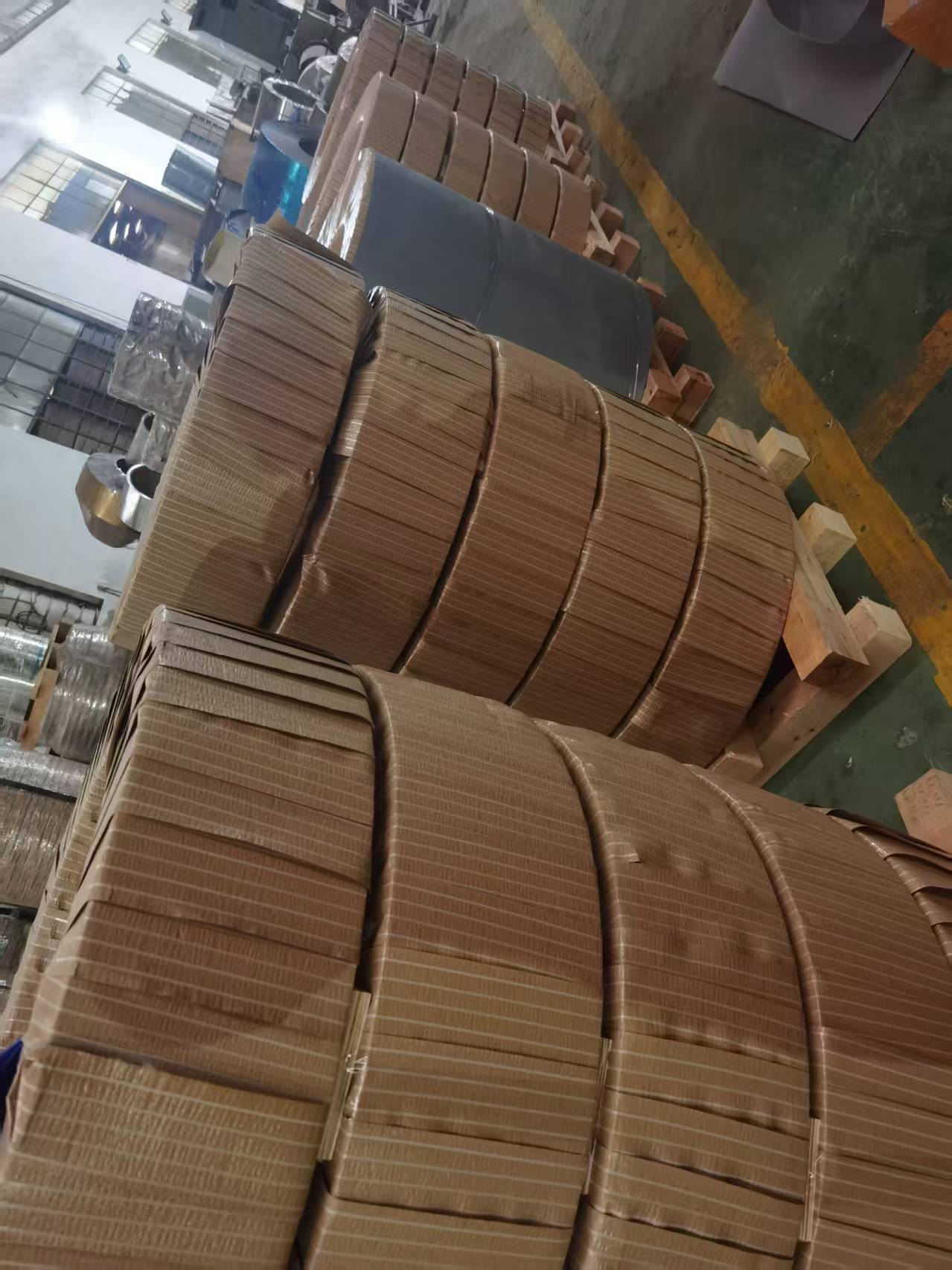
Send your part drawing, required thickness and colour reference, and YOUNGSON METAL will supply a mirror gold, mirror bronze, matte anodized-look or copper-look sample coil for press trialling, together with MTC EN 10204 3.1 documentation and a landed-cost comparison against your current plated or stainless specification.
Website: www.youngsonmetal.com
Email: info@youngsonmetal.com
Tel: 0086-23-62566629 | WhatsApp: 0086-13594107385
Full technical catalogue and specification sheets: Download the Chongqing Youngson Metal Products catalogue (PDF)
Have Questions or Need More Details?
Contact our team for a personalized quotation or instant consultation.
Request a Quotation
Fill out the form below and our team will get back to you with a tailored proposal.
WhatsApp Direct Chat
Prefer to chat in real-time? Message us on WhatsApp for instant assistance & quick answers.
- Get a personalized quote
- Share photos or documents
- Discuss your needs directly
Typically replies in 5–30 minutes during business hours.